
Lihat juga


 06.11.2026 08:01 AM
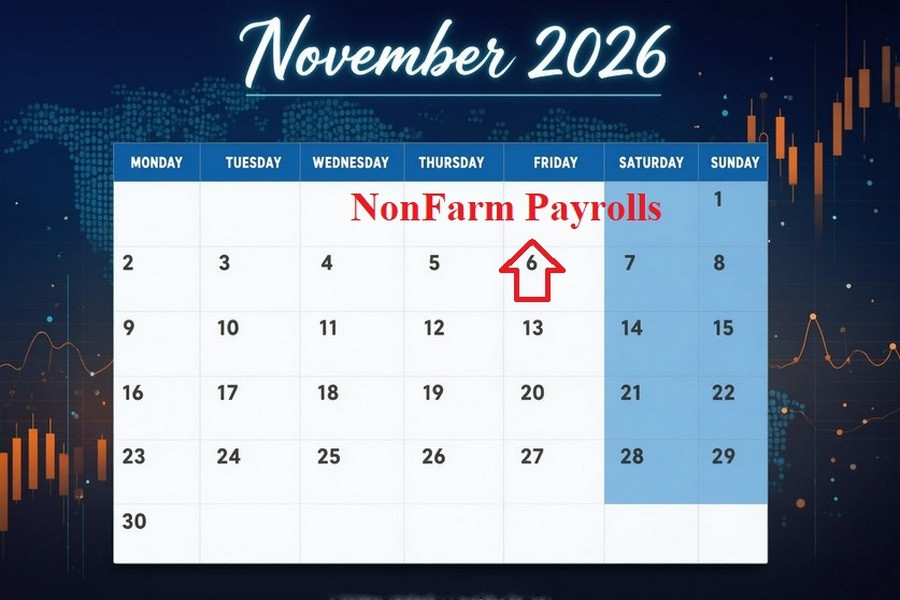
The drama around October's Nonfarm Payrolls is wound up to a peak. All the US preliminary indicators — from ADP and JOLTS to Challenger releases and ISM activity indexes — have combined into a paradoxical picture:
The market awaits the October numbers with particular apprehension because of September's failure, one of the bleakest months of the year for the US labor market. The economy added a token 29,000 jobs versus the market's expected +94,000, and the unemployment rate rose from 4.1% to 4.2%. Moreover, the Bureau of Labor Statistics (BLS) revised down payrolls for the previous two months by a total of 60,000. July's result was revised into negative territory (-10,000). Nonfarm Payrolls for August were cut by almost a third, from 162,000 to 133,000. At the time this looked like a harbinger of a hard recession. However, a fresh set of leading indicators has forced analysts to reassess sharply.
ISM signals — a factory freeze vs. services resilience
ISM readings show a structural split across corporate America. In manufacturing (ISM Manufacturing Employment), the employment subindex stubbornly sits in contraction at 46.0 (readings below 50 signal contraction). High borrowing costs, weak external demand and geopolitical risks have forced manufacturers to put hiring on hold.
In services (ISM Services Employment), the picture is fundamentally different: the subindex remains above the waterline at 51.8, signalling continued hiring. Service companies remain the lone driver of permanent job creation in the country, preventing the labor market from spinning out.
The automatic data provider ADP's report on Wednesday, November 4, delivered the week's first pleasant surprise. Private payrolls rose by 86,000 in October, comfortably ahead of consensus of roughly 69–75k. The September estimate was barely revised — from 90k to 86k. The structure of gains reflects the consumer-driven nature of the economy. Leaders were sectors tied to domestic demand:
The month's anti-hero was professional and business services, which lost another 27k jobs. That sector has cut staff for three months in a row — worrying because it historically acts as a barometer of top-management confidence at large firms. Wage pressures, however, remain far from exhausted. Workers who changed jobs in the ADP sample saw average total pay gains (including bonuses and overtime) of +7.6% — the sharpest jump since March 2024. "People are being drawn to new jobs by bonuses, overtime and more hours in addition to higher base pay," ADP chief economist Nela Richardson noted.
The September JOLTS report (released November 3) delivered a second dose of upside whose full implications the market has yet to digest. Openings jumped by 333,000 to 7.52 million (a 4.5% job-openings rate) versus the ~7.1m analysts had expected. August was revised up to 7.19m. Flow dynamics were even more revealing:
Reuters aptly summarized the state of play as "low-hire, low-fire." High corporate profits and resilient household spending keep layoffs at troughs, but geopolitics (notably the conflict with Iran) forces firms to be cautious about expanding payrolls. EY-Parthenon sees first signs of thaw: the labour market is "relatively strong but frozen," and is beginning to stir.
The Challenger, Gray & Christmas report (Nov. 5) confirmed the picture. US firms announced 43,994 job cuts in October — only 2% more than September but 71% below October last year, and the smallest monthly total since 2023. Year-to-date, corporations have announced 617k cuts — down 44% from the same period in 2025. Big tech remains the primary source of announced reductions.
Since January, tech giants have cut 171.5k jobs (+21% y/y). The key trigger is reorganising processes around generative AI. The report's main focus, though, is seasonal hiring: 470.4k temporary openings announced year?to?date (up 26% y/y) more than offset permanent hires. Corporations prefer flexibility to permanent contracts:
"This is a low-layoff environment. Employers hold on to staff ahead of the holidays, and hiring is mostly short-term seasonal work — companies want flexibility to meet holiday demand without increasing permanent payrolls," says Andy Challenger, senior VP.
Weekly Labor Department data confirm the labour market's underlying strength. Initial jobless claims for the week ending October 31 fell to 189,000 — the lowest since mid-July and near multi-decade troughs. The four-week moving average settled at 194,750. The only cautionary note is continuing claims, which have inched up to 1.72 million. Few are being laid off, but those who lose jobs need more time to find new ones.
Median forecasts from FactSet and Reuters paint a mildly positive picture:
Economists' estimates vary widely — from a cautious +45k (KPMG) to an optimistic +120k. Healthcare, education and hospitality are likely to shoulder much of the hiring. Crucially, interpret the magnitude correctly.
KPMG reminds us that due to an ageing labour force and a sharp drop in immigrant inflows, the economy's break-even pace — the monthly job gain needed to keep unemployment stable — is almost zero. Today, the US needs only roughly 30–60k jobs per month to keep the labour market in balance. A 12-month average rise of 41k is no longer alarming; Kiplinger even calls sub-100k monthly gains the "new normal." Given ADP and JOLTS' leading signals, risks to consensus skew to the upside.
Wall Street's nightmare is not weak job growth
The real nightmare for Wall Street would be the dangerous mix of rising unemployment together with accelerating wages — stagflationary dynamics that would trap the Fed. The report is being released in a tense context: the Fed is in a tightening cycle. In September, the central bank hiked by 25 bps, and on October 28 it held the policy rate at 3.75–4.00%.
Hawks dominate Fed leadership. Liza Cook and Beth Hammack openly voted for an immediate 25-bp hike. Fed Chair Kevin Warsh publicly described the labor market as "very positive" and shifted the Fed's focus squarely to fighting inflation. Futures price in a high chance of another hike in December. If tomorrow's release shows strong hiring and hourly earnings accelerating above +0.3% m/m, the Fed's hawks will get an unambiguous case for a decisive strike at markets.
The US labour market ahead of the NFPs looks like a frozen river
On the surface, everything is iced over — layoffs at half-century lows, unemployment around 4.2% and below 4.5% for 59 months (the longest streak since WWII), and corporate cuts falling rapidly. But under the ice there is strong movement:
October's NFP is unlikely to melt the ice completely. But it can provide a clear signal on whether the Fed will lift rates again in December.
November 6, 10:00 / Germany / Industrial production (Sep m/m) / prev.: -1.2% / actual: 2.0% / consensus: 0% / EUR/USD – down
German industrial production rose 2.0% month-on-month in August, recovering from a 1.2% drop in July. The August gain was the strongest since March 2025:
Automotive production fell 5.4% due to summer shutdowns, while energy-intensive industries saw output decline 0.5%. Over three months, manufacturing rose 0.4%. Consensus expected growth to fade to zero in September. The euro therefore risks losing ground and sliding toward local lows.
November 6, 10:00 / UK / Lloyds house price index (Oct) / prev.: -0.4% / actual: 0% / consensus: -0.3% / GBP/USD – down
UK house prices were flat in September. In August, the index fell 0.4%. High mortgage costs continue to restrain buyer activity. Northern Ireland posted a 7.4% annual rise, while Greater London recorded the largest drop of 2.2%. A return to negative readings would heighten worries about the housing market and weigh on the pound.
November 6, 13:00 / Eurozone / Retail sales (Sep) / prev.: 0.4% / actual: 0.8% / consensus: 0.6% / EUR/USD – down
Retail sales in the eurozone rose 0.8% in August. In July, the indicator fell to a two-year low of 0.4%. The long-term average monthly gain is about 1.14%. A slowdown in retail growth to 0.6% would confirm weakness in the consumer sector and weigh on the euro.
November 6, 16:30 / Canada / Employment change (Oct) / prev.: -41.7k / actual: -68.3k / consensus: 13.6k / USD/CAD – down
Canadian employment fell by 68.3k in September — the largest decline in seven months. The public sector lost 70.0k jobs for the fourth consecutive month. Youth employment declined by 48.0k. The employment-to-population ratio fell from 60.8% to 60.6%. A sharp rebound with positive job growth would improve the outlook for the Canadian economy and support the loonie.
November 6, 16:30 / US / Nonfarm payrolls (Oct) / prev.: 133k / actual: 29k / consensus: 65k / USDX (6-currency USD index) – up
US payrolls rose only 29k in September, with employment estimates for the prior two months revised down by a total of 60k.
The financial sector lost 7k jobs. If hiring rebounds, it would confirm labour-market resilience and push the dollar higher.
November 6, 16:30 / US / Average hourly earnings (Oct y/y) / prev.: 3.1% / actual: 3.0% / consensus: 2.9% / USDX – down
In September, annual growth in average hourly earnings was 3.0%, down from 3.1% in August. September's reading was the weakest pay growth since May 2021. A further slowdown would reduce the risk of a wage-price spiral and could cap dollar strength.
November 6, 18:00 / Canada / Ivey PMI (Oct) / prev.: 64.3 / actual: 58.2 / consensus: 58.0 / USD/CAD – up
Canada's Ivey PMI fell to 58.2 in September, retreating from its April 2022 peak.
The hiring subindex rose from 55.0 to 56.5. A contraction in the indicator would signal a cooling in business optimism and weigh on the loonie.
November 6, 18:00 / US / University of Michigan consumer sentiment (prelim., Nov) / prev.: 48.1 / actual: 48.0 / consensus: 48.0 / USDX – volatile
The preliminary University of Michigan consumer sentiment index stood at 48.0 at the end of October, near a five-month low. Perceptions of big-ticket purchase conditions fell by 18%. One-year inflation expectations rose to 4.7%, and long-run expectations increased to 3.5%. Persistently weak sentiment will keep markets on edge and could spike volatility in the dollar.
Nov 6, 03:00 / US / Speech by Dallas Fed President Lorie Logan / USDX
Nov 6, 12:00 / Eurozone / Speech by Sharon Donnery (ECB Supervisory Board) / EUR/USD
Nov 6, 12:30 / Eurozone / Speech by Sharon Donnery (ECB Supervisory Board) / EUR/USD
Nov 6, 17:10 / US / Speech by St. Louis Fed President Alberto Musalem / USDX
Nov 6, 19:00 / Japan / Speech by BOJ Governor Kazuo Ueda / USD/JPY
Nov 6, 20:15 / US / Speech by Fed Governor Michelle Bowman / USDX
Comments from major central bankers are also scheduled throughout the day; their remarks typically trigger FX volatility as they can signal future policy intentions.


