
Veja também


 11.11.2026 09:28 AM
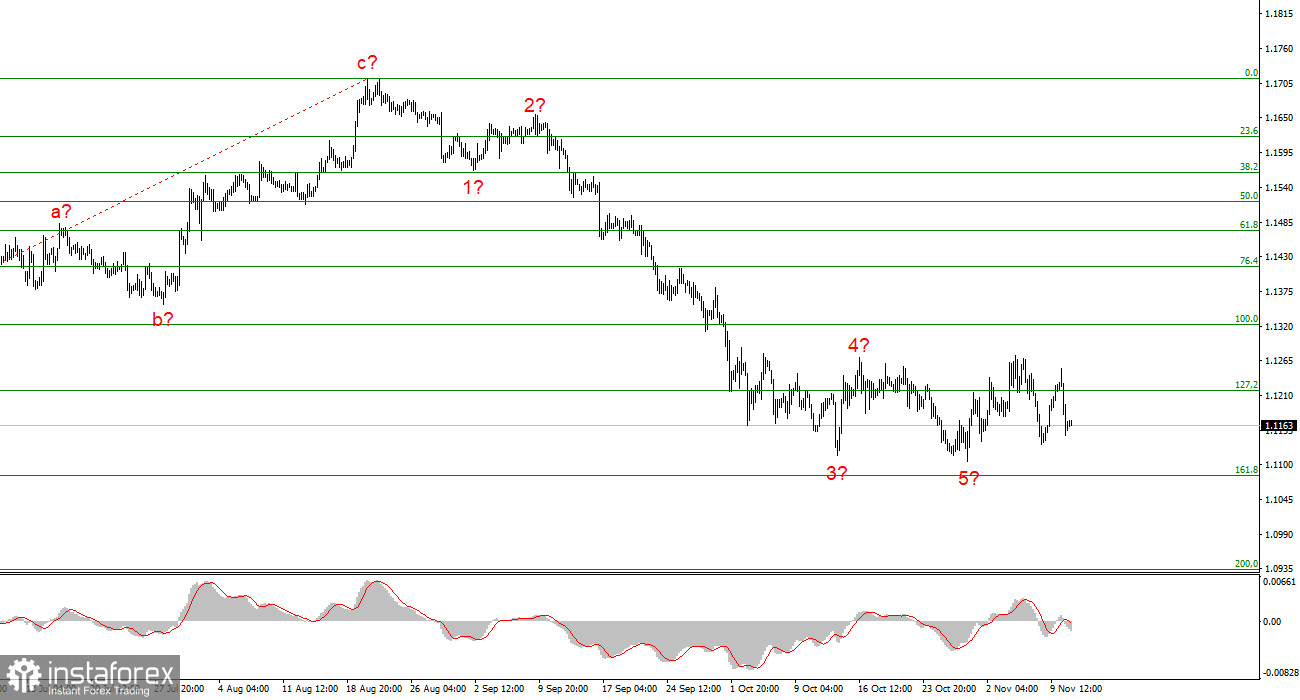
The wave structure on the 4-hour chart for EUR/USD has become more complex. On the higher timeframe (bottom chart), the downward trend segment has taken the form of a five-wave structure, A-B-C-D-E, which may be complete at any moment, as it appears to be fully developed. All the waves within this segment are approximately equal in size, which is why it is considered corrective. If this assumption is correct, the formation of a new impulsive upward trend segment will begin once the correction is complete, with targets well above the 20th level.
On the lower timeframe (top chart), the formation of an impulsive wave structure is continuing, which may belong to wave E of the higher timeframe. If this is indeed the case, then no matter how strongly the dollar rises, its strengthening is nearing an end. The anticipated wave 5 of E is either complete or close to completion. In any case, the current wave structure suggests that the downward wave sequence is nearing completion on both charts. The news background and the sharp shift in market sentiment have led to a significant strengthening of the US currency, but few new reasons remain for further dollar appreciation.
The EUR/USD exchange rate declined by 55 basis points on Tuesday, and there can be only one reason for this: the US inflation report. The Consumer Price Index (CPI) rose by 0.4% month-on-month in October, while the core index increased by 0.3%. In both cases, the market had expected lower readings. Annual figures were not published. Consequently, demand for the US dollar increased quite predictably yesterday, while EUR/USD has remained near its lows for more than a month, maintaining its prospects for the formation of a new upward trend segment. The current wave structure remains relevant.
The only thing left to clarify is what the inflation report actually tells us. Overall, it has changed very little. First, the market cannot assess annual inflation based on monthly figures alone. Second, the decision to raise interest rates at the December 8–9 FOMC meeting can already be considered a foregone conclusion. Third, a week earlier, the European Union also published an inflation report, which indicated that inflation had risen to 4%. Consequently, the ECB should also adopt a more hawkish stance. However, it is difficult to recall the euro appreciating against the dollar by 100 basis points within just a few hours in recent times.
Of course, the fact that European inflation in October matched market expectations should be taken into account. But what difference does that make? The fact that the market correctly anticipated the October figure does not change the fact that inflation in the EU has accelerated. Consequently, inflation is rising faster than expected in both cases: in the United States and in the European Union. Accordingly, both central banks should adopt a tighter monetary policy stance. This means that the dollar should not have an advantage over the euro based on this factor. Geopolitical factors are also not currently supporting the US dollar as a safe-haven currency.
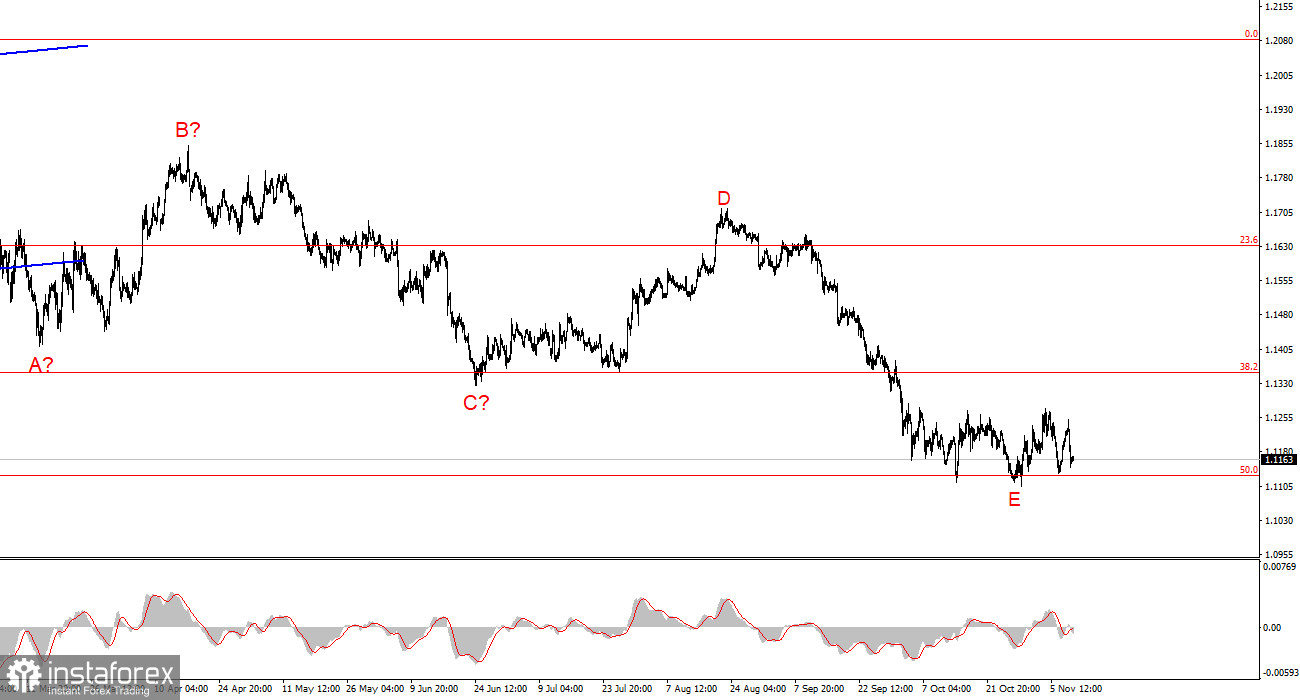
Based on the EUR/USD analysis, the pair remains within the framework of a global corrective trend segment A-B-C-D-E. However, this structure appears to be fully developed and may therefore be complete. In the current situation, it seems like a good time not only to buy the euro but also to anticipate the beginning of a full-fledged upward trend segment. According to the higher timeframe, an advance of at least 17–18 levels should be expected. The unsuccessful attempt to break above the 1.1126 level, which corresponds to the 50.0% Fibonacci retracement level (bottom chart, higher timeframe), also indicates that the market may be ready for further buying.
The higher timeframe shows a downward trend segment that has taken the form of an A-B-C-D-E structure. The internal wave structure of wave E has developed into a five-wave impulse pattern, which may already be complete. If this assumption is correct, the formation of a new upward trend segment should begin now.
The Main Principles of the Analysis:
1. Wave structures should be simple and easy to understand. Complex structures are difficult to trade and often involve changes in the underlying market structure.
2. If there is no clear understanding of what is happening in the market, it is better to stay out of it.
3. There can never be 100% certainty about the direction of market movements. Do not forget to use protective Stop Loss orders.
4. Wave analysis can be combined with other types of analysis and trading strategies.


