
यह भी देखें


 06.11.2026 09:15 AM
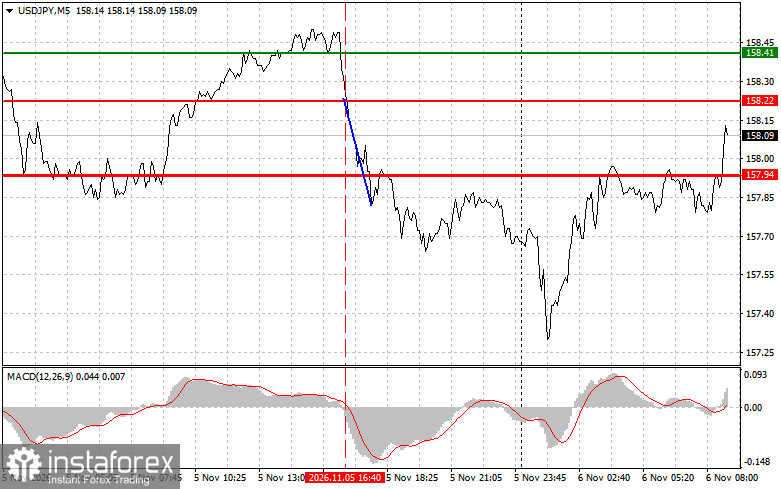
The test of the 158.22 price level occurred when the MACD indicator had just started moving downward from the zero line, confirming a valid entry point for buying the US dollar. As a result, the pair declined toward the target level of 157.94.
Japan reported encouraging wage data, but this may not be enough to support the yen. Nominal wages increased by 4.6% year over year in September, compared with analysts' expectations of 3.8%, while the previous month's growth stood at 3.9%. This result was significantly better than expected and brought the indicator back to July levels, when growth reached 4.7%. These figures are important for the Bank of Japan, as sustained income growth is expected to fuel inflation in the services sector, giving the central bank grounds to continue raising its interest rate, which currently stands at 1.25%. It is worth recalling that the Bank of Japan kept rates unchanged on October 30 following an 8-1 vote, while Hajime Takata called for an immediate rate hike. More than 80% of economists expect a rate increase at the December 17–18 meeting, and today's wage figures further strengthen this scenario.
However, the external environment remains challenging for the yen. Yesterday, US economic data once again supported the dollar. Weekly jobless claims came in at 189,000, compared with the forecast of 197,000. Labor productivity increased by 3.6% in the third quarter, against expectations of 2.8%, while hawkish remarks from Federal Reserve official Beth Hammack about the need for restrictive monetary policy further boosted demand for the US currency. The only concerning signal for the dollar was a 0.7% decline in unit labor costs, but the market barely reacted. Today's main test will be the US employment report, with job growth forecast at 65,000 compared with 29,000 in September. Later in the evening, Bank of Japan Governor Kazuo Ueda is also scheduled to speak.
In my view, the overall picture is mixed. Strong Japanese wage growth and expectations of a December rate hike provide solid support for the yen. However, as long as US economic data continue to exceed forecasts and the Federal Reserve maintains its hawkish stance, the yen will struggle to appreciate. If the employment report falls short of expectations, the yen will have an opportunity to recover some of its losses.
As for the intraday strategy, the focus will be primarily on implementing Scenarios #1 and #2.
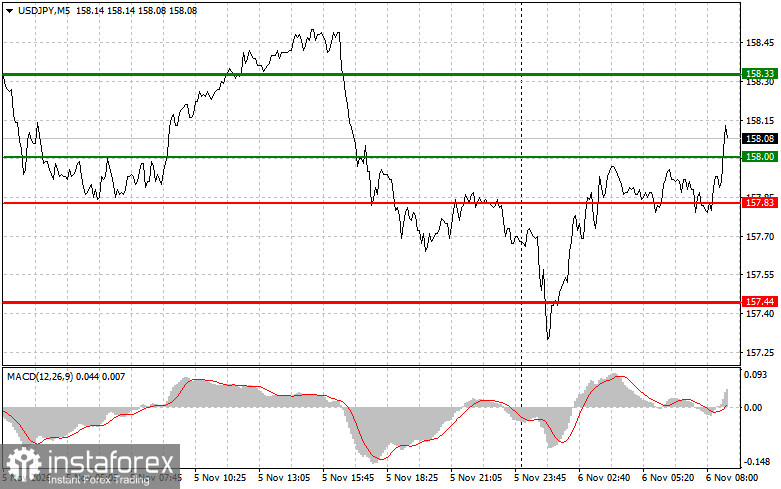
Scenario #1: Today, USD/JPY will be considered for buying when the price reaches the entry level around 158.00 (the green line on the chart), with an upward target of 158.33 (the thicker green line on the chart). Around 158.33, the long position will be closed, and a short position will be opened in the opposite direction, targeting a 30–35-point move from that level. It is preferable to resume buying the pair during corrective pullbacks and significant declines in USD/JPY. Important! Before buying, make sure that the MACD indicator is above the zero line and has just started rising from it.
Scenario #2: USD/JPY will also be considered for buying today if the price tests the 157.83 level twice consecutively while the MACD indicator is in the oversold zone. This will limit the pair's downward potential and trigger an upward market reversal. A rise toward the opposite levels of 158.00 and 158.33 can then be expected.
Scenario #1: Today, USD/JPY will be considered for selling only after the price breaks below the 157.83 level (the red line on the chart), which should lead to a rapid decline in the pair. The sellers' main target will be 157.44, where the short position will be closed and a long position opened immediately in the opposite direction, targeting a 20–25-point move from that level. Sellers could return at any moment; all it would take is any indication from the central bank. Important! Before selling, make sure that the MACD indicator is below the zero line and has just started declining from it.
Scenario #2: USD/JPY will also be considered for selling today if the price tests the 158.00 level twice consecutively while the MACD indicator is in the overbought zone. This will limit the pair's upward potential and trigger a downward market reversal. A decline toward the opposite levels of 157.83 and 157.44 can then be expected.
Important. Beginner Forex traders should exercise extreme caution when making entry decisions. It is best to stay out of the market ahead of major fundamental data releases to avoid exposure to sharp exchange rate fluctuations. If trading during news releases, always place stop-loss orders to minimize potential losses. Without stop-loss orders, the entire trading account balance can be lost very quickly, especially when trading large position sizes without proper money management.
Remember that successful trading requires a clear trading plan, such as the one presented above. Making spontaneous trading decisions based on current market conditions is inherently a losing strategy for an intraday trader.

