
আরও দেখুন


 12.11.2026 01:33 PM
The euro has recovered some of its losses, but this rebound should not be attributed to the ECB's Economic Bulletin. EUR/USD rose to 1.1098, having traded around 1.1080 in the morning, while the overnight low was near 1.1067.
The ECB's Economic Bulletin, which the bank publishes to explain its assessment of the economy and prices, contained no new information. It reiterated what the market already knew following the October 29 meeting. Interest rates were left unchanged at 2.50%, inflation accelerated to 3.8% in September, and the Governing Council has no predetermined path for interest rates. At the time, Christine Lagarde said that the Council had discussed a rate hike but had concluded that it could afford to wait. The bulletin contained neither new hawkish signals nor any indication of faster monetary tightening. Expectations of a rate hike to 2.75% at the December 17 meeting therefore remain unchanged.
The current move looks much more like a technical correction. The euro lost more than 140 points over two days, and after such a sustained wave of selling, a rebound is almost automatic. Many market participants are closing short positions, or bets on a decline, which is pushing the price higher. Meanwhile, the fundamental backdrop for the dollar has not changed. The probability of a Fed rate hike in December is estimated at more than 96%, up from approximately 80% on November 9, while US Treasury yields remain high. Therefore, the euro's recovery appears limited and is unlikely to develop into a sustained reversal for now.
Market attention will now shift to the United States, where there are plenty of potential catalysts for renewed demand for the dollar. Weekly initial jobless claims data will be released, showing the number of people who have filed for unemployment benefits for the first time after losing their jobs. The forecast is 195,000, following 189,000 previously, while the previous reading matched the lowest level since 1969. Such a low number of claims indicates that relatively few people in the United States are losing their jobs, providing another argument in favor of a hawkish Fed. Existing home sales for October will follow, with expectations of 3.87 million compared with 3.99 million previously.
However, the main focus will be on speeches by members of the Federal Reserve's policy committee. Beth Hammack, Barr, Goolsbee, and Daly are scheduled to speak. On November 5, Hammack spoke about the need to maintain restrictive monetary policy. In early September, Barr stressed the need to remain prepared to raise interest rates, while Goolsbee described this week's inflation report as concerning. If they maintain this tone, the dollar could receive another boost.
The price is currently trading near 1.1098, just below the upper boundary of the 1.1069–1.1102 level. A move beyond this boundary is known as a breakout, but a single touch is not enough. The price needs to establish itself beyond the level, meaning that several consecutive five-minute candles must close above or below it. Otherwise, there is a risk of a false breakout, after which the price may return to the range.
The key resistance level is 1.1102. A sustained move above it would open the way toward 1.1133 and then 1.1167. The price is just four points away from this level, so a breakout could occur at any moment. However, further gains may prove difficult because the current rise lacks fundamental support. The first target at 1.1133 is also close to Friday's low of 1.1131, which has now become resistance. Further upside would require a new catalyst, and the only potential catalyst would be unexpectedly dovish comments from Fed officials. This scenario appears unlikely.
On the other hand, the key level is 1.1069. A sustained move below it would open the way toward 1.1036 and then 1.1004. This is the primary scenario. Overnight, the price had already briefly moved below this level, reaching 1.1067, before immediately recovering. Therefore, a second test could result in a breakout. However, the level is still relatively far away, nearly 30 points below the current price, and the morning rebound must first lose momentum. Entering a position on the first touch would not be advisable.
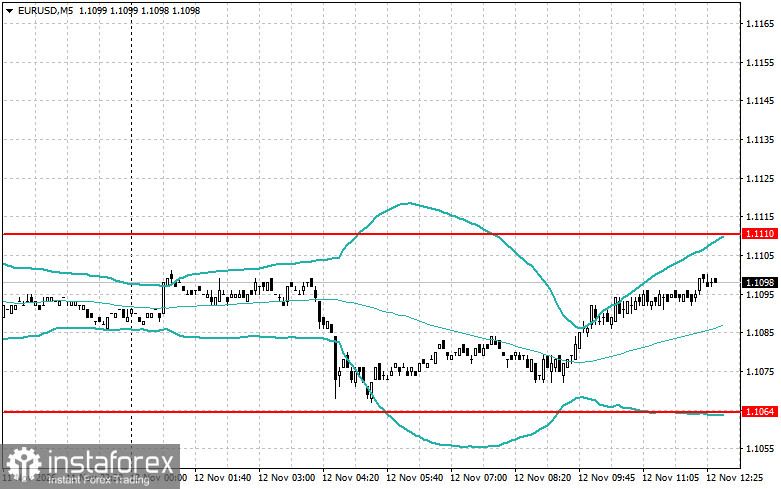
There are two levels to watch here: 1.1110 and 1.1064. The upper reference level at 1.1110 is eight points above the breakout point of 1.1102 and is currently the more important of the two.
The strategy is as follows. The price breaks above 1.1102, reaches 1.1110, fails to extend its gains, and then moves back below the level. In that case, selling opportunities may arise, with a Stop Loss placed slightly above 1.1110. However, if the price establishes itself firmly above 1.1110, this would constitute a genuine breakout, and selling would no longer be advisable. A reversal is more likely if Fed officials deliver hawkish comments and labor market data comes in stronger than expected.
The lower reference level at 1.1064 is five points below the breakout point of 1.1069. Beginners should exercise particular caution here. It is impossible to determine the nature of the move based on a single touch. If the price breaks below 1.1069, reaches 1.1064, fails to extend its decline, and then moves back above the level, buying opportunities may arise, with a Stop Loss placed sufficiently below 1.1064. If the price instead establishes itself below that level, this would be a genuine breakout, and buying would not be advisable. The difference between these two scenarios may become clear within just a few minutes, so it is better to avoid trading the initial reaction in this zone.


