
यह भी देखें


 23.09.2026 07:35 AM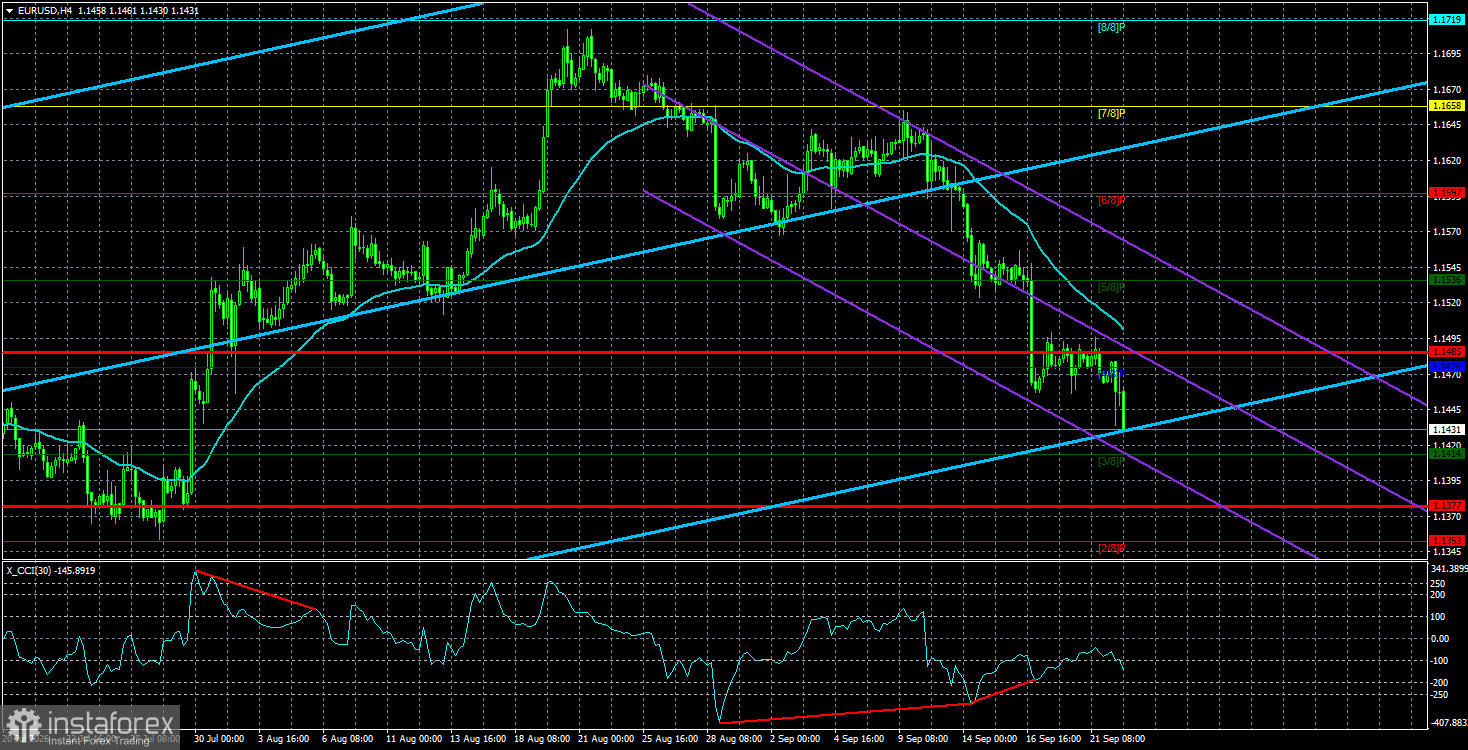
The EUR/USD pair traded with minimal volatility again on Tuesday, but maintained a downward trend. So even on days when market activity approaches zero, the euro still weakens. Almost everyone has weighed in on why the euro is falling: practically all analysts point to the unexpectedly hawkish Federal Reserve stance, which now implies two more rate hikes. We don't understand why Fed tightening matters while European Central Bank tightening doesn't. Yes, the dollar's role in the global economy is far larger than the euro's. But the market has essentially ignored the ECB's rate hikes for the second time — and it is strange that most analysts sidestep this topic as if that were normal.
As we have said, the dollar has no other solid reason to rise besides Fed policy. Thus, the stronger market expectations for further tightening (and we stress, expectations rather than actual Fed actions), the more the dollar can appreciate. From this follows that slowing US inflation would reduce market expectations of further Fed tightening. Inflation can only slow if oil stops rising. Oil will stop rising only if the Middle East conflict remains on pause or ends.
Since the conflict was paused, oil has failed to push toward $120/bbl. It cannot be called cheap, but Brent trading below $100 is a small victory. Thus, the euro's chance of success hinges on lower oil prices — only then could US inflation ease and the Fed be less inclined to tighten further, or at least market expectations for hikes would soften a bit. This is crude logic that ignores many other factors, but if the market ignores them, why should we emphasize them?
This week, a meeting between US President Donald Trump and Iran's Masoud Pezeshkian could hypothetically take place on the sidelines of the UN summit. Some experts have already called this a chance for peace or at least a resumption of talks. If so, the conflict might be winding down, Trump could be pressured to concede with midterm elections approaching, and inflation might slow. We are not among the optimists, so we do not expect any breakthrough in negotiations and do not believe a personal meeting (not even scheduled) will change relations between the two sides. Nevertheless, a hypothetical chance exists, and oil may be falling on the back of such hopes. The dollar, however, continues to rise — responding to any and all events around the world with roughly equal enthusiasm.
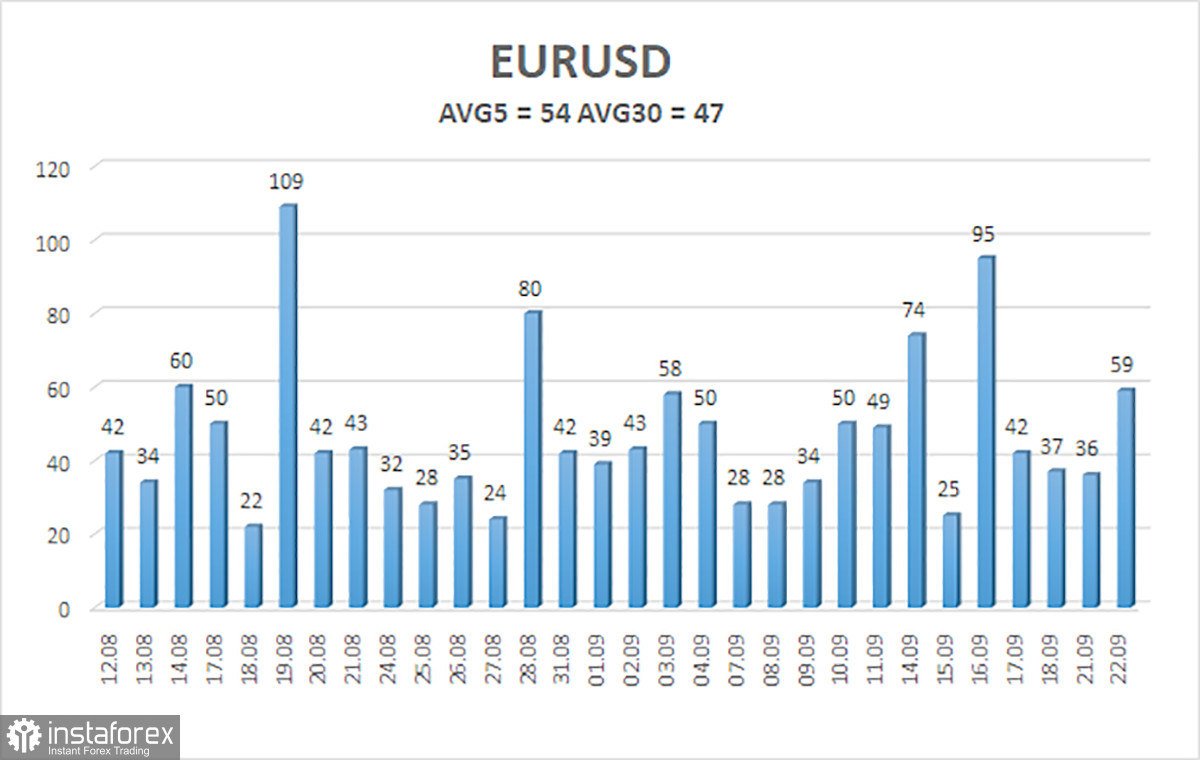
The average volatility of the EUR/USD currency pair over the last 5 trading days as of September 23 is 54 pips and is classified as "medium." We expect the pair to trade between 1.1377 and 1.1485 on Wednesday. The higher linear-regression channel points up, indicating an uptrend. The CCI entered the oversold area twice and formed two bullish divergences, warning of a potential end to the downward correction.
S1 – 1.1414
S2 – 1.1353
S3 – 1.1292
R1 – 1.1475
R2 – 1.1536
R3 – 1.1597
The EUR/USD pair continues to move lower, but we still view the decline as a correction ahead of a new long-term uptrend. The global fundamental backdrop for the dollar remains negative, but in 2026, geopolitics first and then the Fed's hawkish stance provided strong support for the US currency. With price below the moving average, consider short positions with targets 1.1377 and 1.1353. Above the moving average line, long positions remain relevant, with targets at 1.1536 and 1.1597.
Regression channels help determine the current trend. If both are directed in the same direction, it means the trend is currently strong;
The moving average line (settings 20,0, smoothed) defines the short-term trend and the direction in which trading should be conducted at present;
Murray levels are target levels for moves and corrections;
Volatility levels (red lines) are the probable price channel within which the pair will spend the next 24 hours based on current volatility indicators;
The CCI indicator – its entry into the oversold area (below -250) or the overbought area (above +250) indicates that a trend reversal in the opposite direction is approaching.

