
Lihat juga


 06.11.2026 10:05 AM
Today, the MSCI Asia Pacific index plunged 4.1% — the sharpest drop since April 2025. The Nikkei 225 lost 6%, and the Kospi fell as much as 8.8% intraday. Taiwan's index closed down 4.5% and entered a bear market. European futures are sliding too, although the regional MSCI index trimmed some morning losses on a rebound in US futures.
This is clearly a continuation of Thursday's rout, when the S&P 500 plunged 4.4% — the worst performance since the tariff shock in April 2025. The Nasdaq-100 dropped 6.4% and lost $2.3 trillion of market cap. It's the worst week for semiconductors since April last year. Remarkably fast was the shift in logic. As recently as Wednesday, investors were betting that a Democratic wave would speed the end of the Iran war, and tech giants added nearly $1 trillion on hopes that tighter rules on AI spending would ease pressure on cash flows. Now the market sees regulation as a threat to the entire chain from chipmakers to data-centre builders.
The causal chain looks like this. New Democratic Texas governor Gina Hinojosa called for an immediate moratorium on data-centre projects, and winning candidates in other states have echoed that demand. As a result, about 40% of planned US data-centre capacity sits in states where new governors have promised to halt or pause construction. The biggest losers are Nvidia, Qualcomm, and Arm — whose orders depend on build-out pace — and Korean memory manufacturers.
Winners so far are bonds and the dollar. China's 10-year yield fell to an intraday record low on safe-haven demand and excess liquidity; US Treasuries held Thursday's gains, and the dollar strengthened against all G10 currencies.
Oil adds contradictions. Brent rose 1.7% to $99.93/bbl after a 3.9% jump in the previous session. For context: on Wednesday it closed at $94.62, on Thursday morning it was about $93.6, last Monday it closed at $104.77, and at the end of October it had climbed toward $118. Hopes for a quick end to the Iran war after Republican setbacks were overwhelmed by panic around AI, and commodities are retracing some of the fall.
The Fed's main focus remains the US nonfarm payrolls. Consensus suggests that the US economy could have added 65,000 jobs (versus 29,000 in September), with an unemployment rate at near 4.18% versus an expected 4.2%. I believe the market is now reacting to political headlines faster than to measured estimates of real losses. But the risk to the chain is real: 40% of new projects depend on the decisions of incoming governors. All this implies continued volatility in markets and the tech sector in the coming sessions, with only partial rebounds, while the dollar and government bonds are likely to remain beneficiaries.
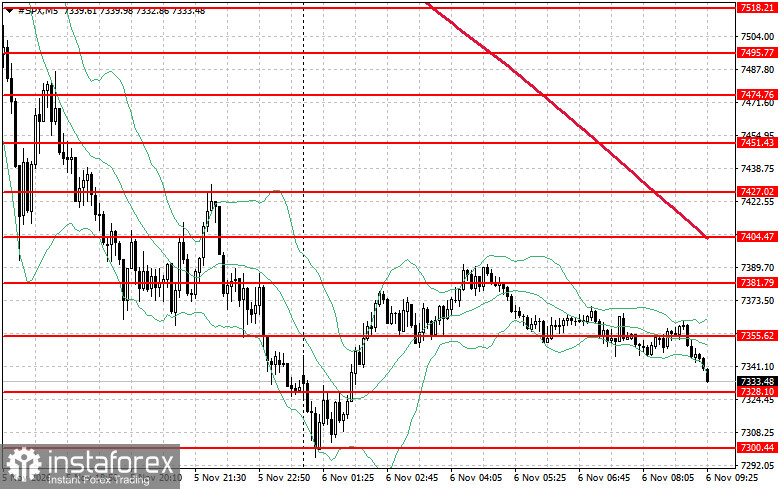
Technical outlook for S&P 500
Buyers' main task today is to overcome immediate resistance at 7,355. That would confirm upside and open the way to a push toward 7,381. Equally important for bulls is holding control above 7,404 to strengthen their positions. On a downside move amid falling risk appetite, buyers must step in around 7,328. A breach would quickly drive the instrument back to 7,300 and open the path to 7,279.


