
Vea también


 17.11.2026 09:00 AM
The 159.67 price test occurred when the MACD indicator had already moved significantly above the zero line, limiting the pair's upside potential. For that reason, I did not buy the dollar.
Today the words of former Bank of Japan governor Haruhiko Kuroda gave the yen additional arguments. Kuroda said that if inflation strengthens, rate increases will inevitably accelerate, and the policy rate could rise even above the neutral level. He pointed to inflationary pressures from the US-Iran war, which makes oil, commodities, and food more expensive for import-dependent Japan, and to tax relief measures that, in his view, will complicate the central bank's task and push prices up, after which the BOJ will have no choice but to raise rates further. This echoes earlier assessments: in October Koeda called the neutral rate noticeably above 1%, and at the October 30 meeting the BOJ raised its inflation forecast for the next fiscal year to 2.6% because of oil. The rate is currently 1.25%, and the next meeting is scheduled for December 17–18.
But for USD/JPY, this is only weak consolation so far, because the Federal Reserve is supporting the dollar. The dollar index remains at a high since May 2025, the 10-year US Treasury yield is around 5.14%, and yesterday's Empire State index of 7.80 versus a 17.60 forecast after 25.50 in October did not shake that backdrop. The Fed funds rate is 3.75–4.00% with a hike expected on December 9, and the gap with the BOJ remains significant.
For the intraday strategy, I will rely primarily on Scenarios 1 and 2.
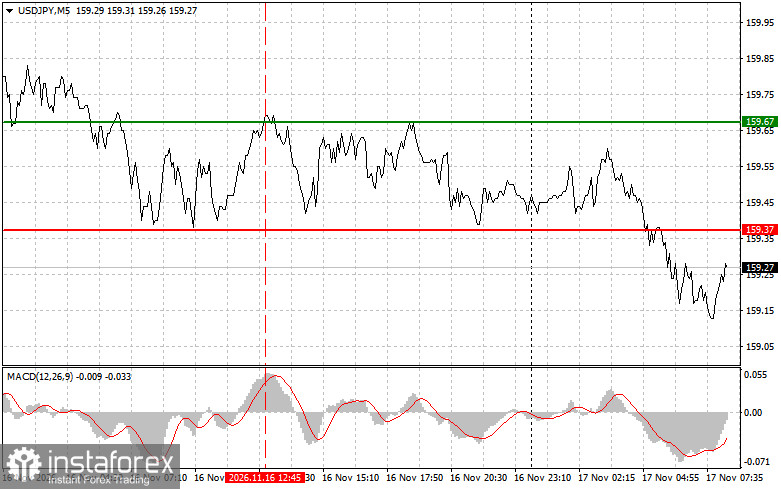
Scenario No. 1: Today I plan to buy USD/JPY when the entry point reaches around 159.34 (the green line on the chart), targeting 159.65 (the thicker green line on the chart). Around 159.65, I plan to exit long positions and open short positions in the opposite direction (expecting a 30–35 pip move back from that level). It is best to return to buying the pair on corrections and significant pullbacks in USD/JPY. Important: before buying, make sure the MACD indicator is above zero and is just beginning to rise from it.
Scenario No. 2: I also plan to buy USD/JPY today in case of two consecutive tests of 159.15 when the MACD indicator is in the oversold area. This will limit the pair's downside potential and lead to an upward reversal. You can expect a rise to the opposite levels 159.34 and 159.65.
Scenario No. 1: Today I plan to sell USD/JPY only after the 159.15 level is broken (the red line on the chart), which will lead to a rapid decline in the pair. The sellers' key target will be 158.87, where I intend to exit shorts and immediately open longs in the opposite direction (expecting a 20–25 pip move back from that level). Sellers can return at any moment; only the slightest hint from the central bank is needed. Important: before selling, make sure the MACD indicator is below zero and is just beginning to decline from it.
Scenario No. 2: I also plan to sell USD/JPY today in case of two consecutive tests of 159.34 when the MACD indicator is in the overbought area. This will limit the pair's upside potential and lead to a downward reversal. You can expect a decline to the opposite levels of 159.15 and 158.87.
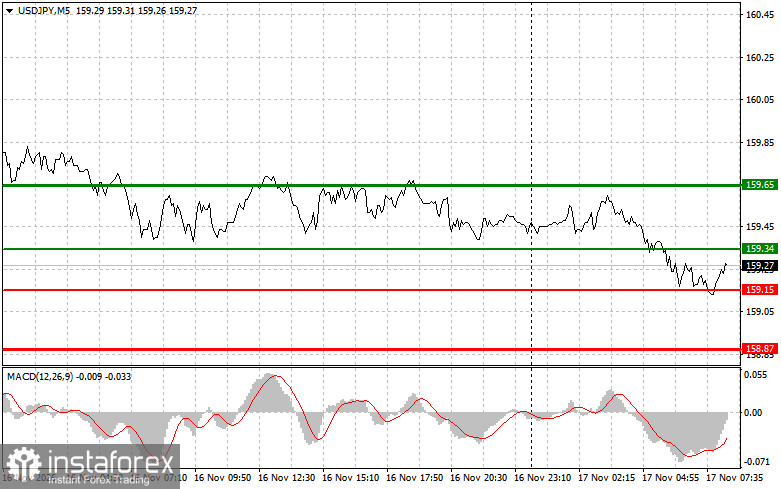
Thin green line – the entry price at which you can buy the trading instrument;
Thick green line – the suggested price where you can place a Take Profit or manually lock in gains, since further upside above this level is unlikely;
Thin red line – the entry price at which you can sell the trading instrument;
Thick red line – the suggested price where you can place a Take Profit or manually lock in gains, since further downside below this level is unlikely;
MACD indicator. When entering the market, it is important to follow the overbought and oversold zones.
Important. Beginner Forex traders must be very cautious when making entry decisions. Before the release of important fundamental reports, it is best to stay out of the market to avoid getting caught in sharp price swings. If you decide to trade during news releases, always place stop orders to minimize losses. Without stop orders, you can quickly lose your entire deposit, especially if you don't use money management and trade large volumes.
Remember, successful trading requires a clear trading plan, like the example I presented above. Spontaneous trading decisions based on the current market situation are a losing strategy for an intraday trader from the start.


