
Vea también


 16.11.2026 08:16 PM
On Monday, gold (XAU/USD) remained under significant selling pressure, falling to its lowest levels in the past 13 months. The precious metal is making only limited attempts to recover despite escalating geopolitical tensions in the Middle East, a development that would normally support demand for safe-haven assets under different circumstances.
However, geopolitical uncertainty is not the main driver of gold's weakness. Instead, a substantial reassessment of market expectations regarding the Federal Reserve's (Fed) future interest rate path is supporting the US dollar and pushing Treasury yields higher. This combination of factors creates particularly unfavorable conditions for an asset that does not generate interest income.
Recent US inflation data have significantly changed market participants' expectations regarding the outlook for monetary policy. Rather than anticipating lower borrowing costs, investors are increasingly considering the possibility of another round of monetary tightening, as inflationary pressures have proved more persistent than previously expected. Core Consumer Price Index (CPI) inflation exceeded consensus forecasts for the third consecutive month in October, while Producer Price Index (PPI) data further intensified concerns about persistent price pressures.
MUFG analysts highlight the scale of this reassessment, noting that "market participants have begun pricing in a more aggressive Fed tightening cycle after US core CPI exceeded expectations for the third consecutive month in October and the Fed adopted a more hawkish tone." According to the bank, "the US interest rate market is now increasingly pricing in three consecutive rate hikes in December, January, and March, potentially bringing the effective federal funds rate to 4.6%."
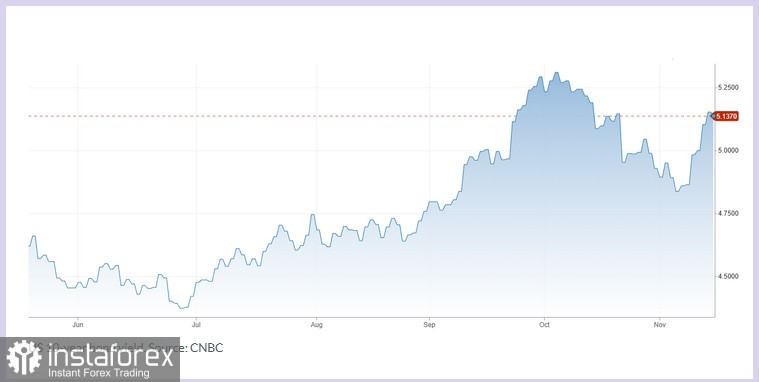
This reassessment of interest rate expectations has become a significant obstacle for gold. Higher interest rates increase the opportunity cost of holding a non-yielding asset, while rising Treasury yields make fixed-income instruments more attractive. The yield on 10-year US Treasury bonds has exceeded 5%, rising by 30 basis points over the week, marking its strongest weekly increase since April 2025.
Under normal circumstances, such developments could support gold prices as investors seek to use the precious metal as a safe-haven asset. However, the market reaction is different under current conditions: capital is increasingly flowing into the US dollar as the primary safe-haven instrument. Meanwhile, the possibility of further increases in oil prices creates a risk of additional inflationary pressure, which could encourage the Federal Reserve to maintain restrictive monetary policy for longer.
As a result, an unusual situation is developing: geopolitical uncertainty is indirectly strengthening the factors weighing on gold prices. It is important to recognize that escalating tensions do not necessarily reduce demand for the precious metal. Rather, the strengthening US dollar and revised interest rate expectations are outweighing the impact of safe-haven buying. Consequently, gold is not receiving the support from geopolitical developments that would traditionally be expected to drive its price higher.
Recent comments from Fed officials have further reinforced expectations of continued monetary tightening. Federal Reserve Bank of Kansas City President Jeff Schmid warned that inflation remains "uncomfortably high" — significantly above the central bank's 2% target — and emphasized the need to contain persistent price pressures. Federal Reserve Bank of Boston President Susan Collins also noted that policymakers may "have to raise interest rates more than previously expected," while advocating a gradual approach to further tightening.
According to the CME FedWatch Tool, the market currently assigns an approximately 92% probability to a 25-basis-point rate hike in December, while the probability of a larger, 50-basis-point increase stands at around 8%. Moreover, traders are also pricing in the possibility of further interest rate increases in January and March. These expectations largely explain why gold continues to move lower despite rising geopolitical risks.
From a technical perspective, market sentiment on the daily gold chart has deteriorated noticeably. XAU/USD tested the $3,830 level, establishing it as a monthly low. The Relative Strength Index (RSI) is near 35, indicating weakening momentum but not yet confirming deeply oversold conditions. At the same time, gold is trading below both its 100-day and 200-day Simple Moving Averages (SMAs), further confirming the negative market sentiment. A sustained break below $3,830 would open the way toward the psychologically significant $3,800 level. Such a development would strengthen the prevailing bearish sentiment.
On the other hand, holding above $3,830 could allow for a temporary recovery. However, gold would need to return to the $4,100 level to achieve a substantial improvement in its technical outlook. This level is above the 20-day SMA. At this stage, the key question is not whether geopolitical tensions will persist, but whether the Federal Reserve's hawkish stance will leave sufficient room for gold prices to recover. As long as the US dollar remains strong amid expectations of higher interest rates, even escalating geopolitical uncertainty is unlikely to reverse the precious metal's downward trend.


