
Vea también


 12.11.2026 01:33 PM
The pound received positive news, which pushed it higher. The GBP/USD pair rebounded from its overnight low of 1.3249 and is trading around 1.3274, close to the upper boundary of the range.
The rebound was driven by UK economic data, which exceeded expectations in almost every category. September GDP, which measures the total value of goods and services produced by the country over the month, increased by 0.2% after remaining unchanged at 0.0% in August, while the forecast was close to zero. Industrial production rose by 0.3%, against expectations of a 0.3% decline. Manufacturing output increased by 0.7%, compared with an expected decline of 0.5%, while construction output rebounded from a 0.5% decline to growth of 0.8%.
Quarterly GDP growth of 0.7% confirmed expectations and exceeded the previous reading of 0.5%. Overall, the economic picture improved considerably compared with the situation seen in recent weeks, when data more often disappointed market participants.
These figures are important for the Bank of England. On November 5, Andrew Bailey said that a second rate increase was more likely than not, although he noted that the outlook depended partly on energy prices. The Bank raised its interest rate to 4.00%. The market had continued to assign roughly equal probabilities to a rate increase and no change in December, but the stronger economic data have strengthened the case for another increase.
Market attention will now shift to the United States, where there are several potential catalysts for renewed demand for the dollar. Weekly initial jobless claims data will be released, showing the number of people filing for unemployment benefits for the first time. The forecast stands at 195,000, compared with 189,000 previously. This will be followed by October existing home sales, which are expected to reach 3.87 million, down from 3.99 million. However, the main focus will be on speeches by Federal Reserve officials. Beth Hammack, Michael Barr, Austan Goolsbee, and Mary Daly are scheduled to speak. On November 5, Hammack spoke about the need for restrictive monetary policy, while Barr stressed the need to remain prepared to raise interest rates in early September. Earlier this week, Goolsbee described the inflation report as concerning. In this context, a hawkish tone from Fed officials could restore demand for the dollar. The pound is therefore likely to remain under pressure through the end of the day, while the UK economic data have provided only partial support.
The price is currently trading around 1.3274, almost at the upper boundary of the range, while the lower boundary is at 1.3241. A move beyond either boundary is called a breakout, but a single test of the level is not sufficient. The price needs to consolidate beyond it, meaning that several consecutive five-minute candles must close above or below the level. Otherwise, the move could turn out to be a false breakout, followed by a return to the range.
The key resistance level is 1.3275. Consolidation above this level would open the way toward 1.3301 and then 1.3328. The price is already testing this level, and it briefly moved above it overnight, reaching 1.3281, but failed to hold there and subsequently declined. Buyers now have support from the strong UK economic data. If the Fed does not adopt a more hawkish tone, a breakout is possible. However, the probability of a move higher appears lower than that of a downward reversal, particularly given that four Fed officials are scheduled to speak today.
The key support level is 1.3241. Consolidation below it would open the way toward 1.3209 and then 1.3183. This is the primary scenario. Today's low of 1.3249 did not reach the level, but if Fed officials deliver hawkish remarks and US economic data prove strong, demand for the dollar could return, potentially pushing the price down by more than 30 points in a short period. Entry should be considered only after candles close below the level.
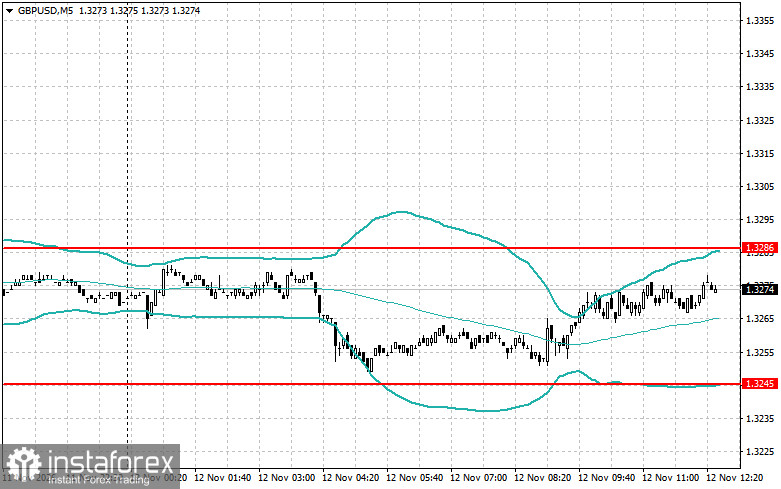
There are two key levels here: 1.3286 and 1.3245. The upper level of 1.3286 is 11 points above the breakout level of 1.3275 and also above the overnight high of 1.3281. The scenario is as follows: the price breaks above 1.3275, reaches 1.3286, fails to extend its gains, and then moves back below the level. In this case, short positions could be considered, with a stop-loss placed slightly above 1.3286. However, if the price consolidates firmly above 1.3286, this would confirm a genuine breakout, and short positions should be avoided at that level. A reversal is more likely if Fed officials adopt a hawkish tone and the positive UK economic data have already been priced in.
The lower level of 1.3245 is only 4 pips below the breakout level of 1.3241, so beginners should exercise particular caution here. A single test of the level is not enough to determine the nature of the price movement. If the price breaks below 1.3241, reaches 1.3245, fails to extend its decline, and then moves back above the level, long positions could be considered, with a stop-loss placed slightly below 1.3241. If the price instead consolidates below this level, the move would confirm a breakout, and long positions should be avoided. The difference between these two scenarios may become clear within just a few minutes. Therefore, it is better to avoid trading the initial reaction in this zone and wait for a clearer signal.


