
Veja também


 23.11.2026 06:14 AM
The EUR/USD currency pair avoided a new drop for the second straight day on Friday — arguably the third — which is some measure of progress for the euro. That said, nothing surprising occurred. As we have repeatedly noted, over the past three months the euro has either fallen or traded sideways. A few weeks ago we observed a month-long flat at the lows; now we see another flat at the lows with virtually no corrective moves. On Friday the only semi-notable items were another speech by European Central Bank President Christine Lagarde — her third this week — which again contained no new monetary-policy guidance, and the University of Michigan consumer-sentiment second-estimate in the U.S. The market already knew the Michigan reading well in advance, so the release had limited impact.
Technically, EUR/USD left the 1.1115–1.1261 sideways channel and resumed an almost free fall, then last week began forming a new sideways range. The downward move remains strong and relentless; it's hard to draw a trendline because clear price extremes are missing. Price is simply sliding progressively lower.
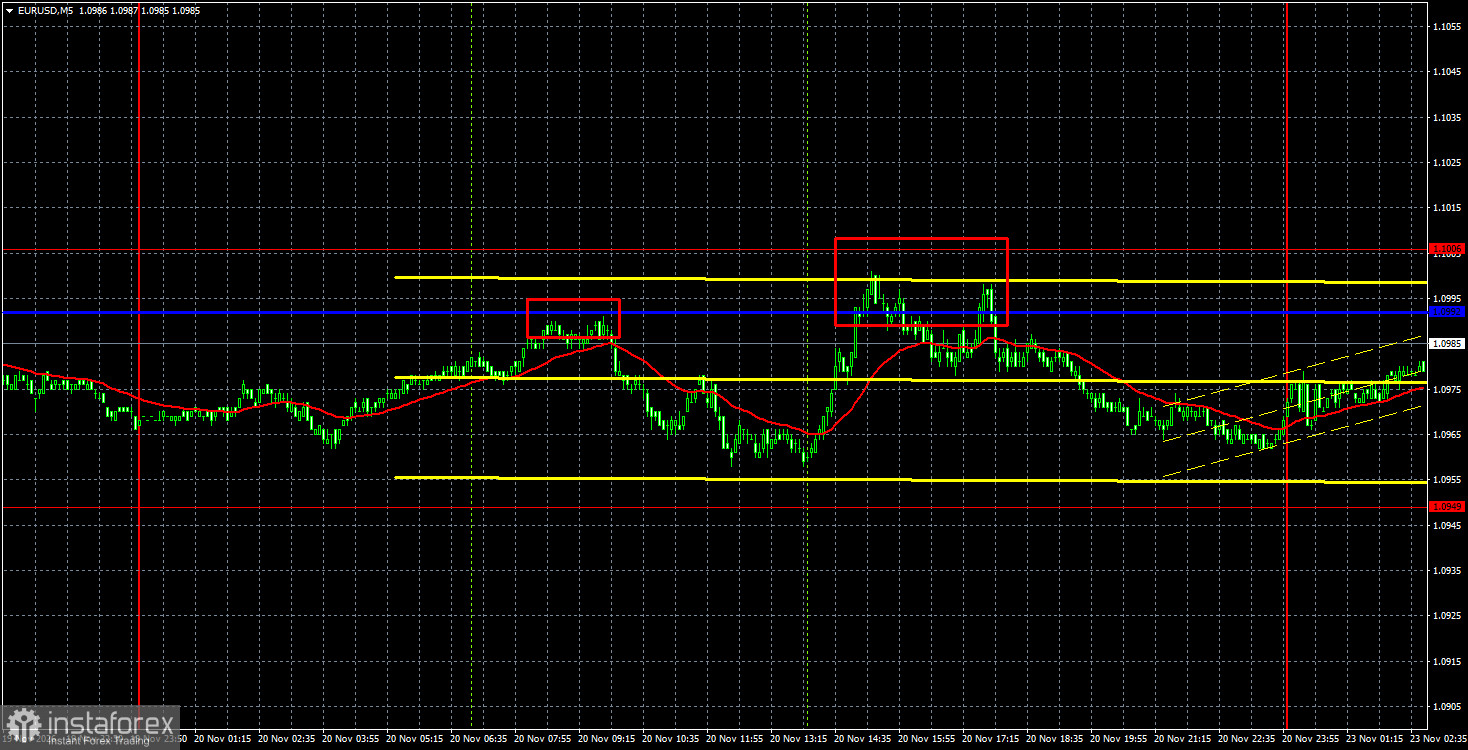
On the 5-minute TF, two trading signals formed on Friday. The pair first bounced off a key Kijun-sen line, then off the 1.0992–1.1006 area. Both declines were modest and occurred within the newly forming sideways channel, whose lower bound can be drawn near 1.0949.
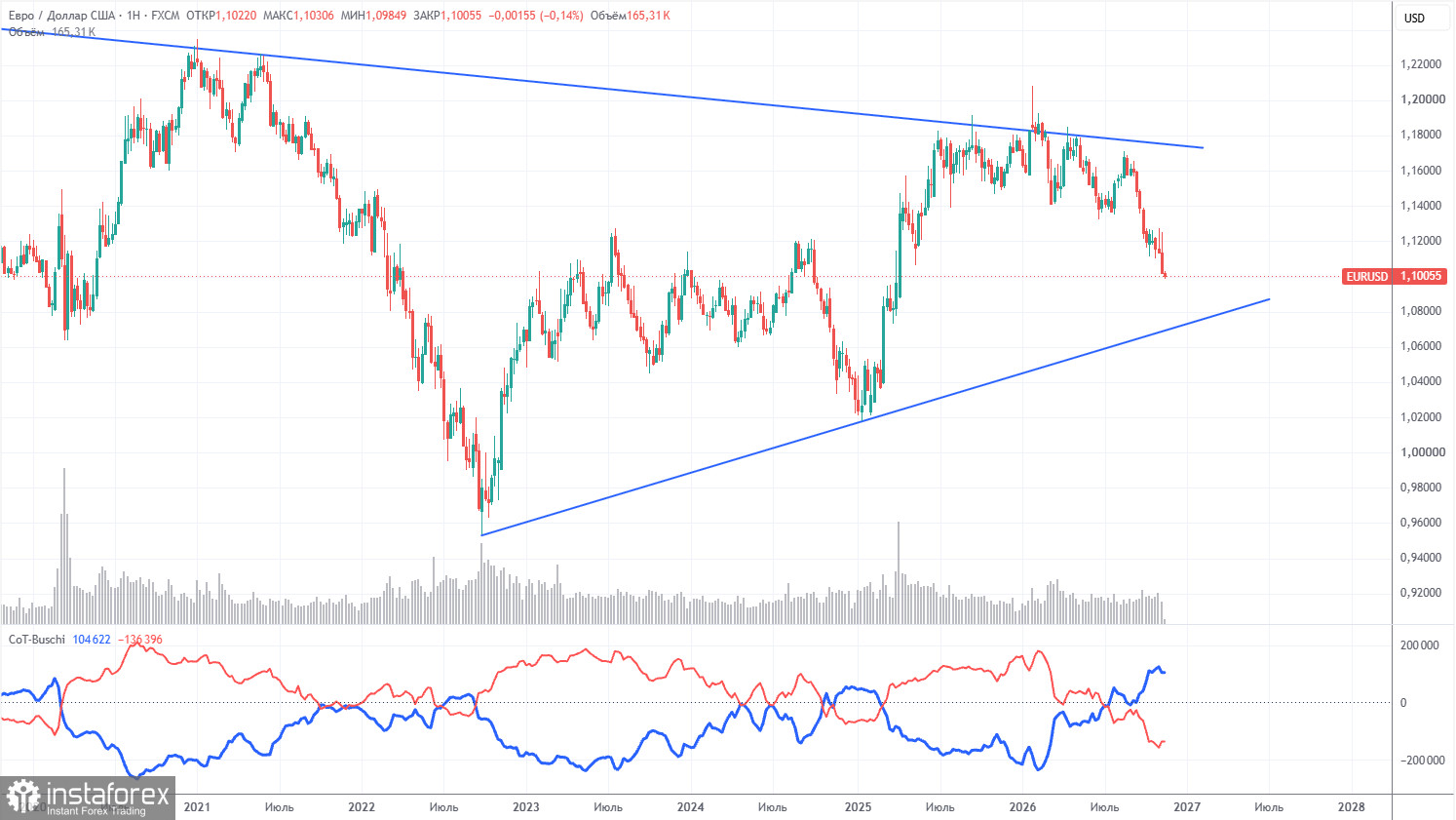
The latest COT report (dated November 10) shows non-commercial traders remain net bearish on the euro and have trimmed long exposure sharply through 2026 amid geopolitical events and Federal Reserve tightening. Traders have been selling the euro and buying the dollar for the past nine months. Political developments in Washington are unlikely to change the dollar's long-term case.
We still see no fundamental factors that would clearly support further dollar weakness. The Middle East conflict made the dollar temporarily very attractive, and the Fed's monetary stance has surprised the dollar higher for a second time this year. In the long term, the euro could fall toward the $1.08 trendline, although the underlying multi-year uptrend would remain intact. Recently, however, the market has been counting only factors positive for the dollar and ignoring everything else.
The red and blue COT indicator lines point to a bears' advantage. Over the last reporting week, non-commercial long positions fell by 1,900 while short positions rose by 23,300, so the group's net position increased by 21,400 contracts.
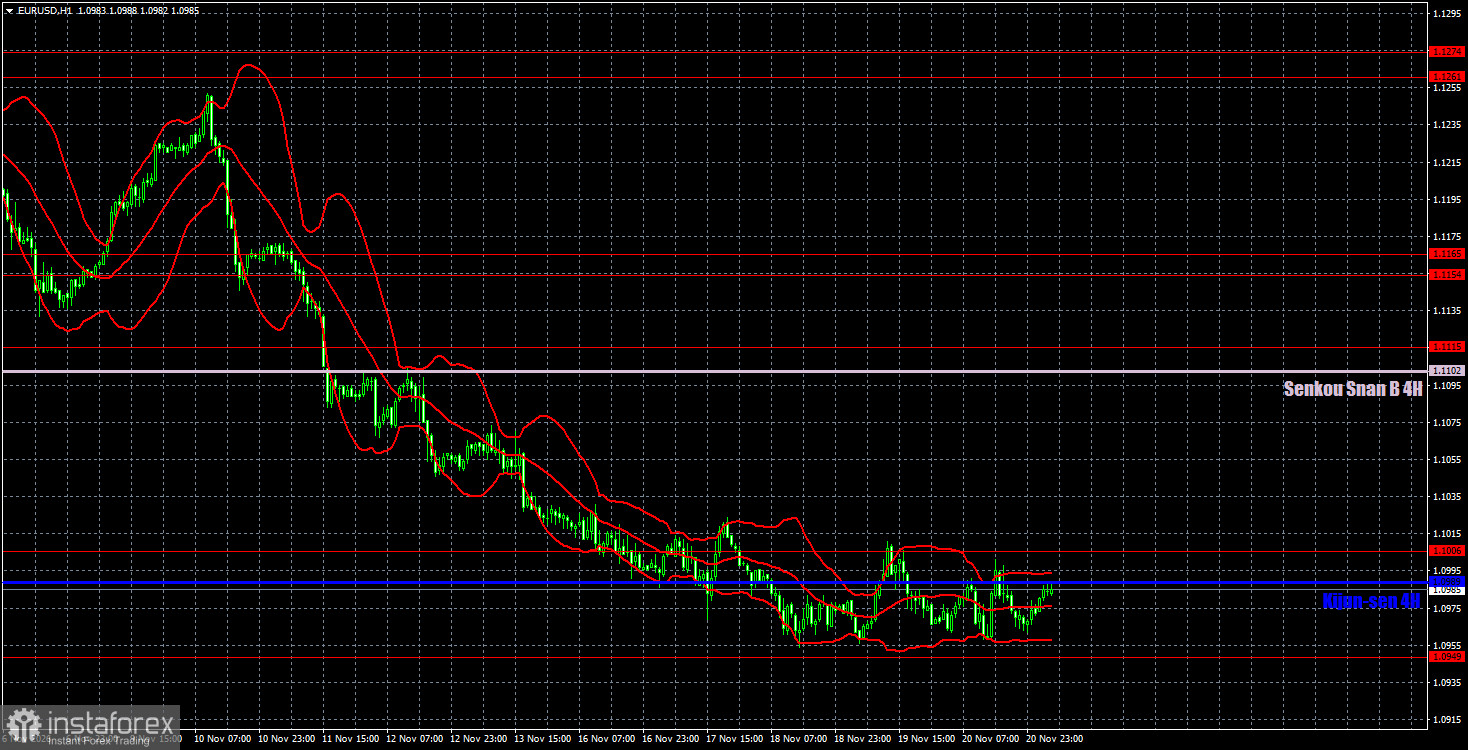
On the hourly timeframe, the EUR/USD pair continues its three-month downtrend without a single significant correction. Over the past three months, the market has shown no willingness to buy the euro, regardless of fundamental, macroeconomic, or geopolitical factors. The euro is in free fall and, at best, trading sideways.
For November 23 we highlight the following levels for trading — 1.0886, 1.0949, 1.1006, 1.1115, 1.1154–1.1165, 1.1261–1.1274, 1.1362–1.1368, 1.1461–1.1473, 1.1536–1.1542, as well as the Ichimoku Senkou Span B line (1.1102) and Kijun-sen (1.0989). The Ichimoku indicator lines may move during the day, so account for this when determining trading signals. Remember to move your Stop Loss to breakeven if the price has moved 15 pips in the correct direction. This will protect against potential losses if the signal proves false.
On Monday, the eurozone, Germany and the U.S. will publish initial November business-activity (PMI) readings for manufacturing and services. These indices may cause a modest market reaction, but EUR/USD is trading flat and is unlikely to receive strong support from the indicated PMIs.
Traders may consider shorts near 1.0949 if price rebounds from 1.1006. If price consolidates above 1.1006, consider a long position at 1.1102.


