
Veja também


 13.11.2026 09:00 AM
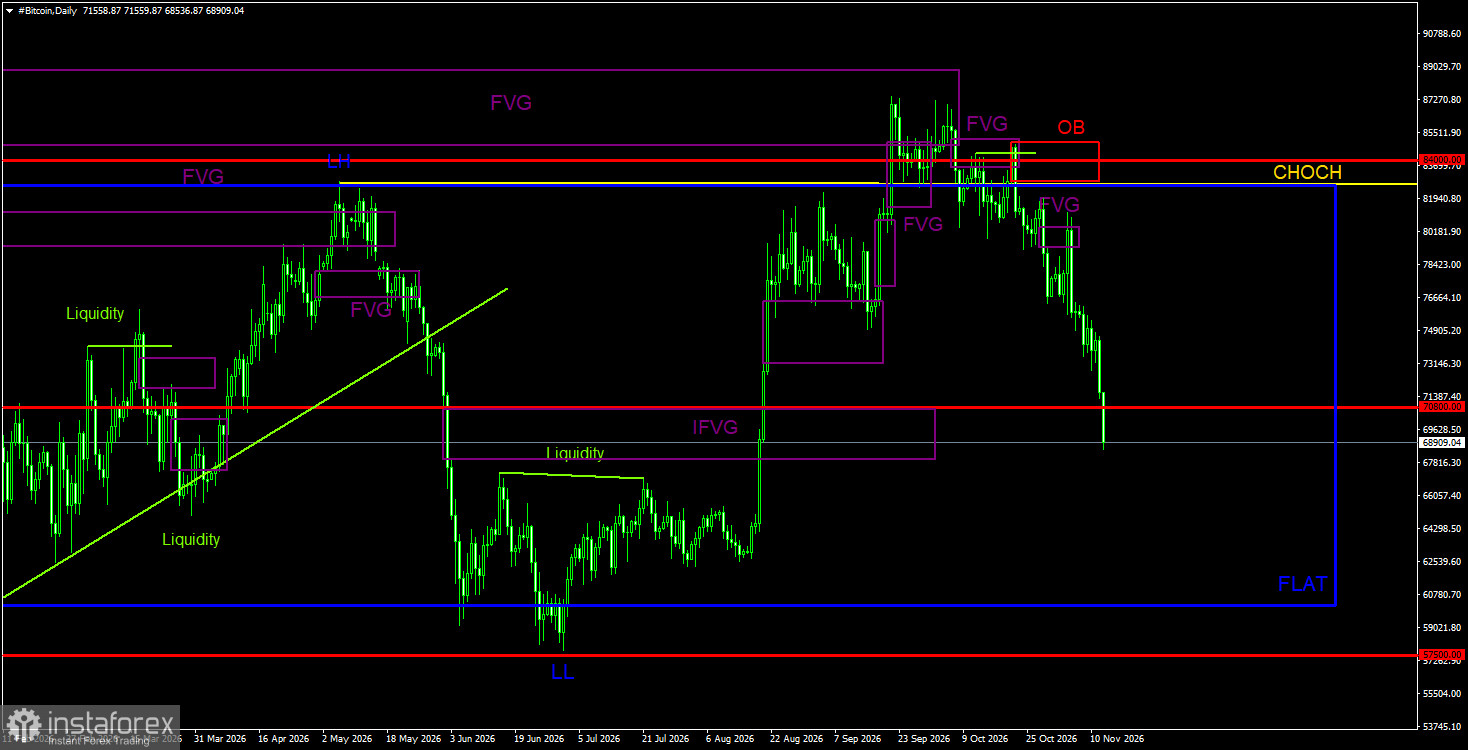
Bitcoin and Ethereum continue their downward move, constantly fed by one discouraging piece of news after another. I remind you that recent developments for the crypto world have been overwhelmingly negative. Central banks (notably the Federal Reserve) keep tightening monetary policy; the Clarity Act remains just a bill; Democrats won control of Congress, further reducing the likelihood that the Clarity Act will pass. Historically, Bitcoin tends to fall after midterm elections (which we are seeing now), and two weeks ago, the list of negatives grew with the hack of the world's largest crypto exchange, Binance. That was followed by a crash in the US stock market and a sell?off in tech shares, which many experts link closely to Bitcoin's price. This week, US inflation accelerated more than expected, further boosting the market's hawkish Fed bets. The cherry on top was the resignation of Nvidia CEO Jensen Huang — which triggered mass capital outflows from tech stocks. The equity sell-off in turn pulled down the crypto market. So, the fundamental case for Bitcoin's rise remains, to say the least, shaky.
As noted, Jensen Huang stepped down as Nvidia CEO this week. The company said the change of the top executive will not disrupt operations and that commitments to investors and product-development plans will be met. Still, investors are selling the stock because they dislike uncertainty. A new head of one of the world's largest companies could change strategic direction. How Nvidia will operate and evolve now is unclear, so investors prefer to move capital from a troubled Nvidia into other stocks and instruments. Experts believe that the departure of not only the CEO but also a founder will leave a mark on long-term strategy execution and negatively affect investment in the company and the AI sector.
In addition, MSCI announced that it removed Strategy's shares from the MSCI USA and MSCI Japan Small Cap indices. The decision followed a reassessment of index-inclusion criteria. In recent years, Strategy has transformed from a major software developer into a treasury-like company that "puts all its eggs in one basket." Many investors and analysts are now worried about its future.
Bitcoin tried to start a new uptrend, but the fundamental backdrop, spot demand and recent news are too negative to expect its continuation. In the near term, on the daily timeframe, Bitcoin may remain in decline: the price has already reacted to three bearish FVGs and formed a bearish order block. Bitcoin remains inside a sideways channel, generated a reversal signal near its upper boundary and has worked through the $70,800 level. Short positions remain more relevant than longs for now, with targets at $60,200 and $57,500. The latest bearish FVG on the daily chart produced a fresh sell signal. On the 4-hour timeframe, there is another bearish FVG, a reaction to which could give traders an opportunity to open new short positions.
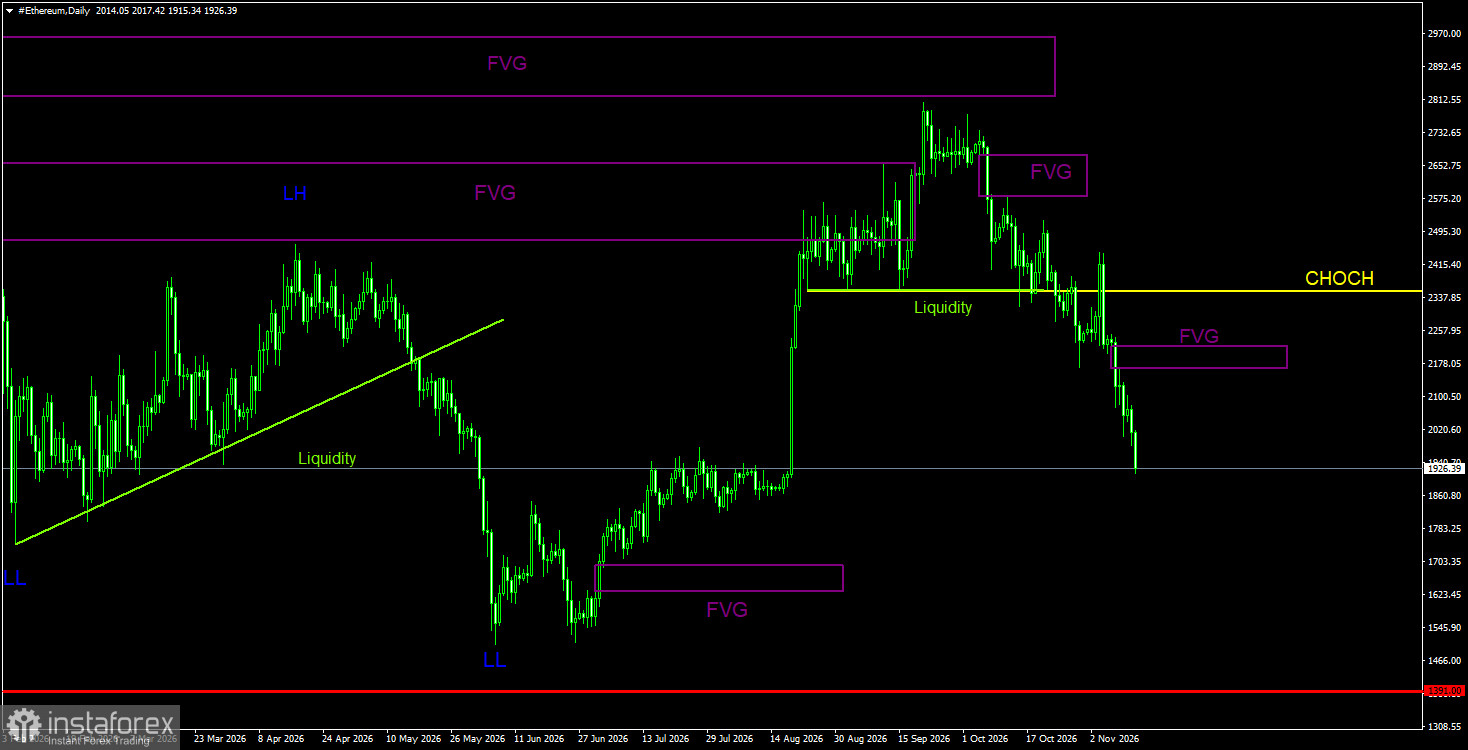
The daily technical picture for Ethereum has changed. Ethereum made a substantial upward run in June–September 2026 that could mark the start of a new long-term trend. However, there is no confidence that Bitcoin's bearish trend has ended. If Bitcoin remains in a downtrend or even flat, Ethereum's rally should not be expected. Bitcoin's daily chart shows enough sell signals and bearish patterns to continue downward, so we also expect Ethereum to fall. Targets are around $1,850 and $1,391. On the 4-hour timeframe, there is a new bearish FVG that serves as a POI for short positions.
CHOCH is a change of character / break of the trend structure. Liquidity means traders' Stop-Losses that market makers use to build their positions. FVG stands for a Fair Value Gap (an area of price inefficiency). The price often moves quickly through such areas, indicating the absence of one side in the market. Later, the price tends to return and react to these zones. IFVG is an Inverted Fair Value Gap. After a return to such a zone, the price does not react but impulsively breaks through and then tests it from the other side.
OB means an Order Block. A candle on which a market maker opened a position in order to harvest liquidity and then form their own position in the opposite direction.


