
Veja também


 06.11.2026 06:27 PM
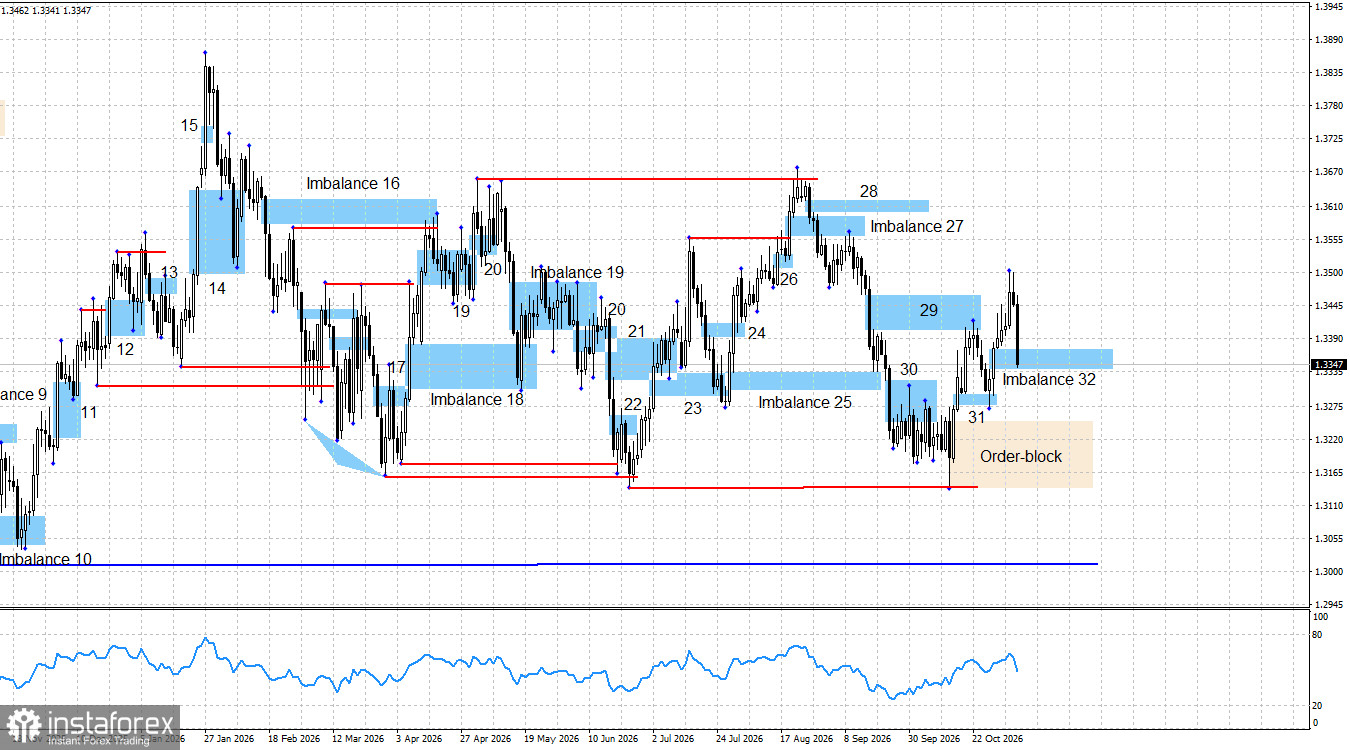
GBP/USD continues to advance within its annual trading range. At the end of the week, strong US labor market data triggered a sharp counterattack by sellers, but they encountered Bullish Imbalance 32. Yesterday, it was noted that a corrective pullback could actually be a favorable development for buyers, as it would provide an opportunity to open new long positions. Today's price action has confirmed this outlook. Sellers are unlikely to have enough momentum to break through Imbalance 32 today. The bullish impulse within the trading range remains intact, and the target around 1.3670 has yet to be reached. Therefore, under the current circumstances, a buy signal is expected to form within Imbalance 32, potentially followed by another advance in the pound next week. Naturally, changes in the news background may affect traders' plans, but future developments cannot be predicted with certainty. At present, buyers retain excellent prospects for further gains.
This week, the Bank of England implemented its first monetary policy tightening measure, which generally supports bullish sentiment among traders. The market reaction to this decidedly hawkish development was rather mixed. Buyers did not resume their advance, even though the outcome of the Bank of England meeting could be considered the most hawkish possible. The Bank of England not only raised interest rates as expected, but its Monetary Policy Committee (MPC) also voted unanimously to tighten monetary policy. This provides grounds to expect further policy tightening, potentially as early as December. Thus, the dollar dominated the final trading sessions of this week, but the pound could gain the upper hand over the next several weeks.
Another important factor supporting the pound's outlook is that traders expect the Bank of England to implement at least three monetary policy tightening measures in total, compared with just one or, at most, two expected from the Fed. Naturally, the course of events in 2027 remains uncertain, but this is currently the prevailing market expectation. Consequently, the Bank of England may ultimately raise interest rates more aggressively than the Fed over the coming months, which is unlikely to support further gains in the US currency. In the near term, only geopolitical developments could provide additional support for the dollar, particularly if Donald Trump decides to resume military operations against Iran. It is also important not to draw direct parallels between the euro and the pound at this stage. These two currencies have recently been trading quite differently, even though they usually exhibit a strong correlation.
Do sellers have any prospects? In my view, their potential is limited. Over the past two months, sellers have pushed the dollar to the highest levels within the trading range. It is worth remembering that the market has repeatedly had compelling reasons to buy the dollar in 2026. However, there have also been reasons for the pound to strengthen, which traders have frequently overlooked. Thus, unlike the euro, the dollar and the pound have generally followed a logical pattern throughout the year, with alternating periods of appreciation and depreciation that collectively form a trading range.
The economic news released on Friday provided sellers with an opportunity to launch an attack, but this move is unlikely to be sufficient to reverse the bullish impulse. The Nonfarm Payrolls report and unemployment rate both showed strong figures, allowing the Fed to continue monetary policy tightening with greater confidence. However, as already mentioned, the Bank of England is also expected to raise interest rates, meaning that the dollar does not have a clear advantage. It received substantial market support today, but further gains will require additional convincing reasons and supporting factors. Whether such factors emerge will become clear next week.
The overall fundamental picture remains such that, in the long term, further weakness in the US dollar appears to be the most likely scenario. The war between Iran and the United States has not changed this outlook. Geopolitical developments prompted the market to reconsider the dollar's safe-haven status for several months, but the conflict is currently on hold. Therefore, until hostilities resume, a new sustained advance by sellers is not expected. Unfortunately, further escalation remains possible, and media reports increasingly refer to the possibility of a "nuclear bomb" being used. According to some media reports, Trump could consider using nuclear weapons to secure Iran's unconditional surrender. It can only be hoped that these reports are inaccurate.
On November 9, the economic calendar contains no significant events. The economic news background is therefore unlikely to influence market sentiment on Monday.
The long-term outlook for the pound remains bullish. Buyers have controlled market momentum in recent weeks, although only within the trading range, which is clearly visible on the daily chart and remains intact. The liquidity sweep below the June lows allowed buyers to regain control. Therefore, the short-term market structure is considered bullish. For traders, this means that existing long positions should be maintained for now, while new bullish signals should be considered for trading opportunities. A buy signal within Imbalance 32 could form as early as today or at the beginning of next week. The pound's targets remain near the upper boundary of the trading range at 1.3670.


