
Veja também


 04.11.2026 05:29 AM
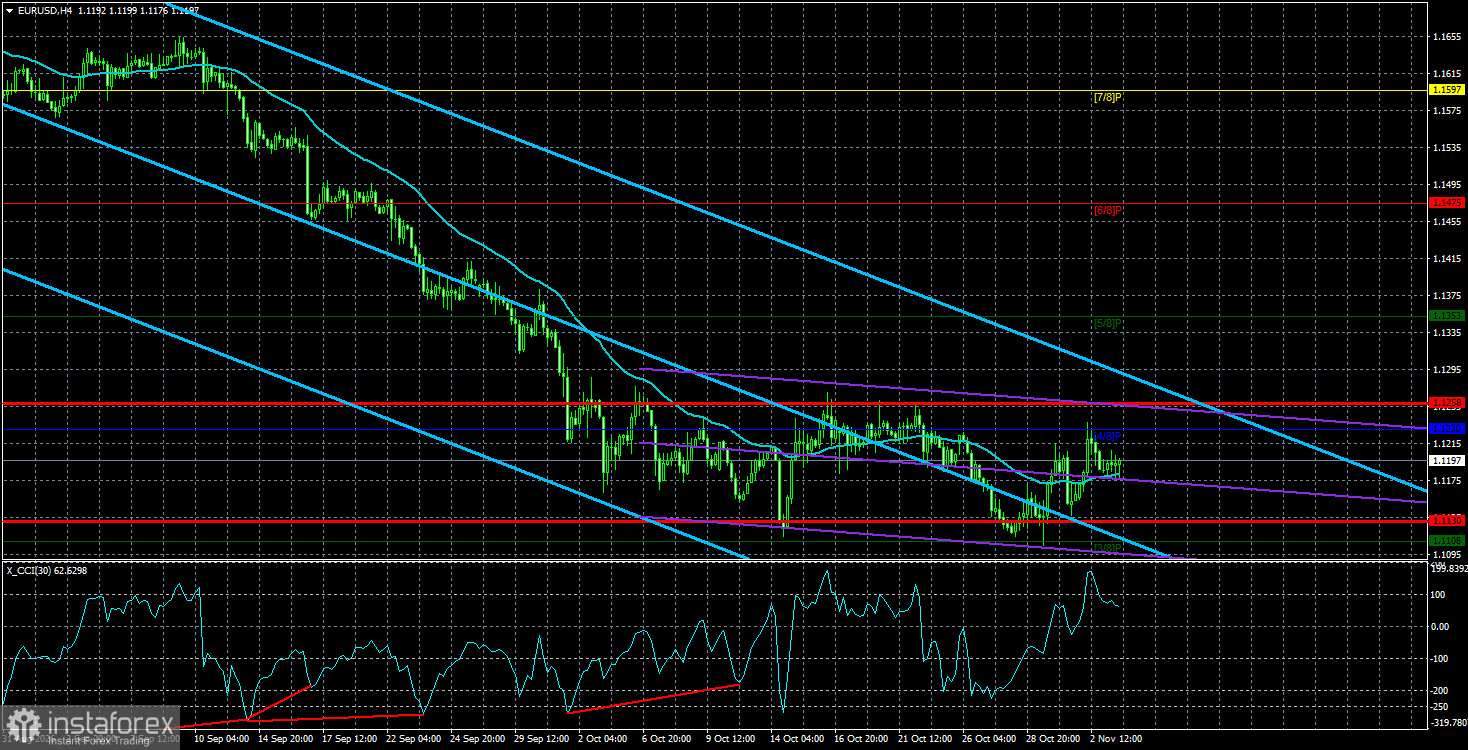
As expected, the EUR/USD currency pair traded calmly on Tuesday, remaining within the same sideways channel in which it has spent the past several weeks. This channel is clearly visible on the 4-hour timeframe. Overall, the euro remains near the bottom of the market, trading at its 18-month lows and showing no signs of an upward reversal. It has become increasingly clear that the current decline in EUR/USD is fundamentally unjustified. Although the euro and the Eurozone are facing serious challenges, with France's domestic situation, geopolitical developments, and the Fed's monetary policy weighing on the European currency, it would be difficult to argue that the euro has experienced no positive developments whatsoever over the past two months. The market continues to overlook stronger-than-expected economic growth in the Eurozone, the ECB's monetary policy tightening, and weakness in the U.S. labor market. If the euro had experienced a more gradual decline over the past two months, with corrections and pullbacks along the way, the current downward movement might have appeared more justified. However, virtually no meaningful pullbacks or corrections have occurred. Therefore, the current movement is still considered entirely speculative and driven by market momentum.
The results of the U.S. congressional elections will become available throughout the day. It should be noted that the final results may not be announced until well after today, as counting all the votes and completing the necessary verification procedures often takes several days or even weeks. However, preliminary results will become available today. There is relatively little uncertainty surrounding this event, as it is widely expected that the Republican Party will lose its outright majority in at least one chamber of Congress. However, numerous experts have suggested in recent weeks that the Democrats could win control of both chambers. In fact, the Democrats need to secure just four more seats than the Republicans in each chamber to gain control. This does not appear to be an unrealistic objective.
The Democrats' main advantage can be summarized as follows: they are not Republicans. After all, the United States experienced its current difficulties under full Republican control of the government. These include the trade war, which resulted in Americans paying $300 billion in tariffs that the Supreme Court subsequently ruled unlawful and overturned; the military campaign in Iran, which drove up oil, natural gas, and other fuel prices, accelerating inflation both in the United States and worldwide; and several changes to immigration policy that have repeatedly prompted protests and demonstrations across the country. It is difficult to determine how many Americans genuinely view the first two years of Trump's presidential term positively. However, recent opinion polls and political approval ratings suggest that this group is relatively small. If Congress had not been entirely controlled by Republicans over the past two years, it would have been possible to argue that Trump had made his decisions with the Democrats' consent, making both parties responsible. However, it is widely known that Trump makes decisions independently without consulting Congress. Consequently, Democrats were unable to influence Trump's executive orders, while Republicans largely played a passive role in congressional proceedings. Therefore, in this assessment, a Democratic victory appears highly likely, and only an unexpected development could help Republicans retain control of even the Senate. A Democratic victory could strengthen the U.S. dollar, but this effect is expected to be short-lived.
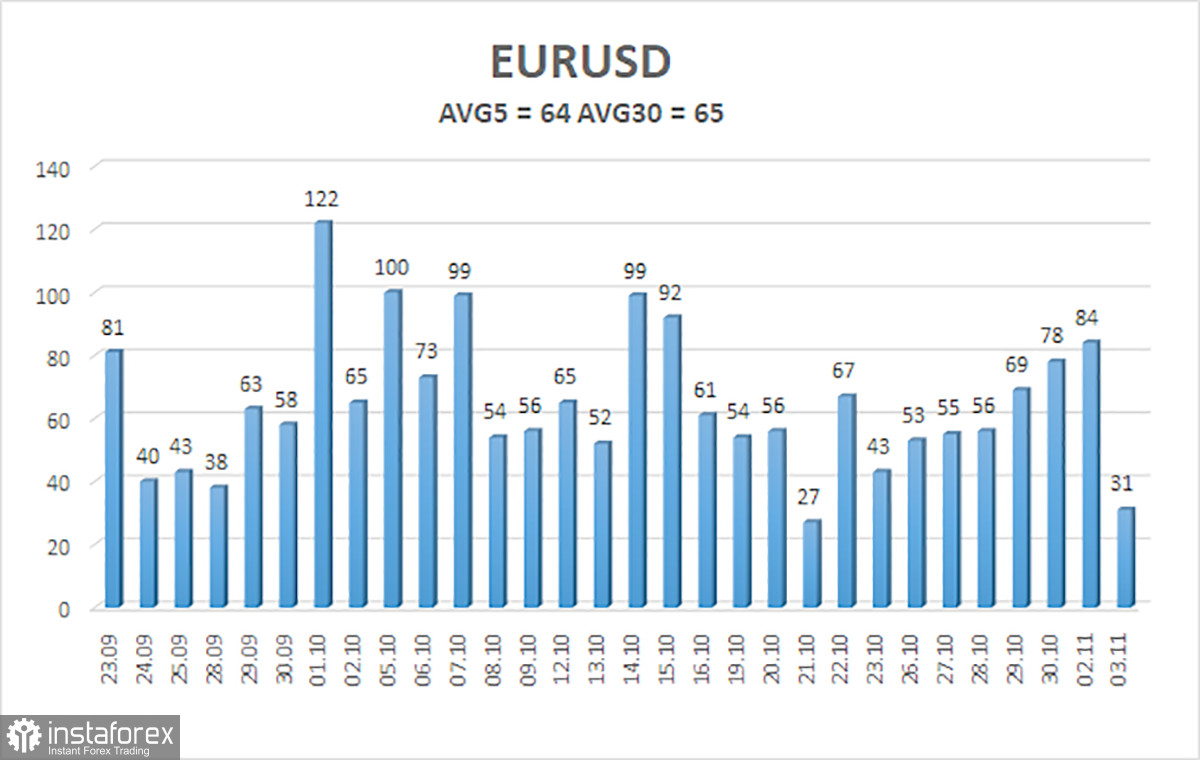
The average volatility of EUR/USD over the last five trading days, as of November 4, stands at 64 points and is classified as "medium." On Wednesday, the pair is expected to trade between 1.1130 and 1.1258. The upper linear regression channel has turned downward, indicating another potential trend reversal. The CCI indicator entered the oversold area five times and formed four bullish divergences, but traders ignored all these signals. The unjustified downward trend remains intact.
Nearest support levels:
S1 – 1.1108
S2 – 1.0986
S3 – 1.0864
Nearest resistance levels:
R1 – 1.1230
R2 – 1.1353
R3 – 1.1475
EUR/USD continues to trade within a downward trend, but the decline is still viewed as a correction ahead of a potential new upward trend. The overall fundamental backdrop remains unfavorable for the U.S. dollar. However, in 2026, geopolitical developments followed by the Fed's hawkish stance provided substantial support for the U.S. currency. If the price remains below the moving average, short positions can be considered with targets at 1.1130 and 1.1108. Above the moving average, long positions remain relevant, with targets at 1.1258 and 1.1353.
Linear regression channels help identify the current trend. If both channels point in the same direction, the prevailing trend is strong.
The moving average (settings: 20.0, smoothed) identifies the short-term trend and the preferred trading direction.
Murray levels serve as target levels for price movements and corrections.
Volatility levels (red lines) indicate the probable price range within which the pair is expected to trade over the next 24 hours, based on current volatility readings.
The CCI indicator entering the oversold area (below -250) or the overbought area (above +250) indicates that a trend reversal in the opposite direction may be approaching.


