
یہ بھی دیکھیں


 23.11.2026 08:06 AM
The pound begins the week with a cautious rebound. On Friday evening, GBP/USD fell from about 1.3118 to roughly 1.3075, then recovered about 36 pips overnight and this morning, and now stands near 1.3111.
UK data on Friday were encouraging, but the pound did not benefit. Retail sales in October rose 0.7% month-on-month versus a 0.0% forecast, while September was revised down from -0.4% to -0.6%. Ex-fuel sales rose 0.9% versus an expected -0.1%. Year-on-year, the headline increased 2.3% versus a 1.7% forecast, and ex-fuel climbed 2.5% versus 0.4% a month earlier. Those figures indicate British consumers are holding up better than feared, which means the Bank of England still has room to tighten further.
One reason the pound's upside was limited on Friday was U.S. data. The final University of Michigan consumer-sentiment index for November printed 51.5 versus a 51.0 forecast and 48.0 in October; the expectations component rose to 52.9 from 48.8. One-year ahead household inflation expectations fell to 3.7% from 4.3%. The Federal Reserve watches that gauge closely because entrenched expectations make inflation stickier. The decline in expectations moderates the case for accelerated tightening, but it barely moved FX markets. In my view, until the BoE meeting in December, the key driver for GBP/USD will remain the dollar's path, while UK data will mainly act to temper downside.
Today the main UK release is the preliminary November PMI suite. PMIs are surveys of purchasing managers; readings above 50 indicate expansion. Services — which account for most of the UK economy — are expected at 53.0 (after 52.8 in October). There is no composite consensus; the prior composite was 52.9, and manufacturing was 52.8. By comparison, in October the preliminary print beat expectations: the composite was 53.1 vs. a 51.8 forecast (an eight-month high), services 53.1 vs. 51.8, and manufacturing 52.8 vs. 51.8. The final services figure came in slightly softer at 52.8, but employment rose for the first time in just over two years. With inflation at 3.6% and the Bank Rate at 4.00%, such data feed directly into expectations of a second BoE hike. A services print above 53.0 would strengthen the case for a December move, but strong dollar demand is unlikely to allow GBP/USD a significant rally.
Now GBPUSD stands at 1.3111, inside the range between 1.3103 and 1.3128, eight pips above the lower boundary and 17 pips below the upper. A breakout is defined as a move beyond the boundary with confirmation — several consecutive five-minute candles closing past the level — because a single touch proves nothing.
On the upside, 1.3128 is active. A confirmed close above it opens the way to 1.3168 and then to 1.3209. Today's high near 1.3116 stopped about 12 pips short of that level, and Friday evening's high around 1.3118 was about 10 pips short. Those two peaks form a ceiling the pair has failed to clear twice. The first target, 1.3168, lies near last week's highs around 1.3168; the second, 1.3209, is near the overnight high on 18 November around 1.3206, so sellers are likely to appear in both zones. Strong business-activity data could provide a lift, but dollar demand remains powerful, and I have little conviction in an upside breakout.
On the downside, the reference is 1.3103; a confirmed close below it leads to 1.3078 and then to 1.3049. I regard this direction as primary. This morning the pair approached 1.3103 and bounced, and Friday evening's low near 1.3075 reached the area of the first target and also produced a bounce. By comparison: the pair was around 1.3449 on 10 November, around 1.3102 on Friday daytime, and now 1.3111 — the rebound is small relative to the decline. It is about eight pips to the level and another 25 pips from there to the first target at 1.3078. If business-activity prints disappoint and dollar demand persists, a close below would produce a rapid drop. I would not enter on the first touch.
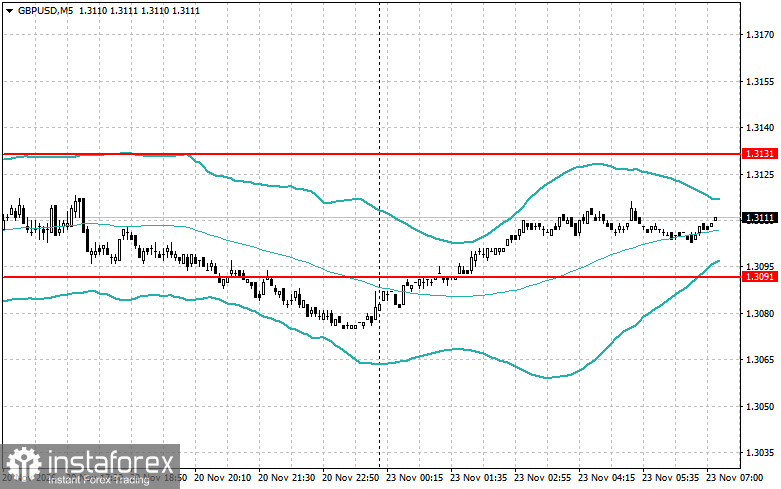
There are two levels here, 1.3131 and 1.3091. The upper reference, 1.3131, sits just three pips above the upside breakout point at 1.3128 and about 20 pips above current price, so caution is required. The marks are nearly merged, and on the first touch it is impossible to tell which scenario has been triggered. If price consolidates above 1.3131, the breakout is valid, and you must not sell. If, however, price reaches 1.3131, finds no continuation, and quickly returns below, I would consider selling toward 1.3091 with a stop above 1.3137 — i.e., just above the breakout level with a small margin. That picture is likely if PMIs print near forecasts and the market retraces after the initial reaction. The difference between the scenarios may unfold over several minutes, so it is better to skip the first reaction in the zone.
The lower reference 1.3091 lies 12 pips below the downside breakout point 1.3103 and about 20 pips below the current price, so the breakout level must be passed first. Friday evening's low near 1.3075 dipped 16 pips below that mark before returning higher, so returns from that zone have already occurred. The scheme is: price closes below 1.3103, falls to 1.3091, cannot hold below it and returns higher — then I look to buy toward 1.3131 with a stop below 1.3085. A buffer is essential because price often slips a few pips beyond the level. A rebound is likely if no new hawkish Fed comments arrive and PMIs print near forecasts. If price confidently consolidates below 1.3091, the return is canceled and the downward breakout to 1.3078 works.


