
یہ بھی دیکھیں


 20.11.2026 05:49 AM
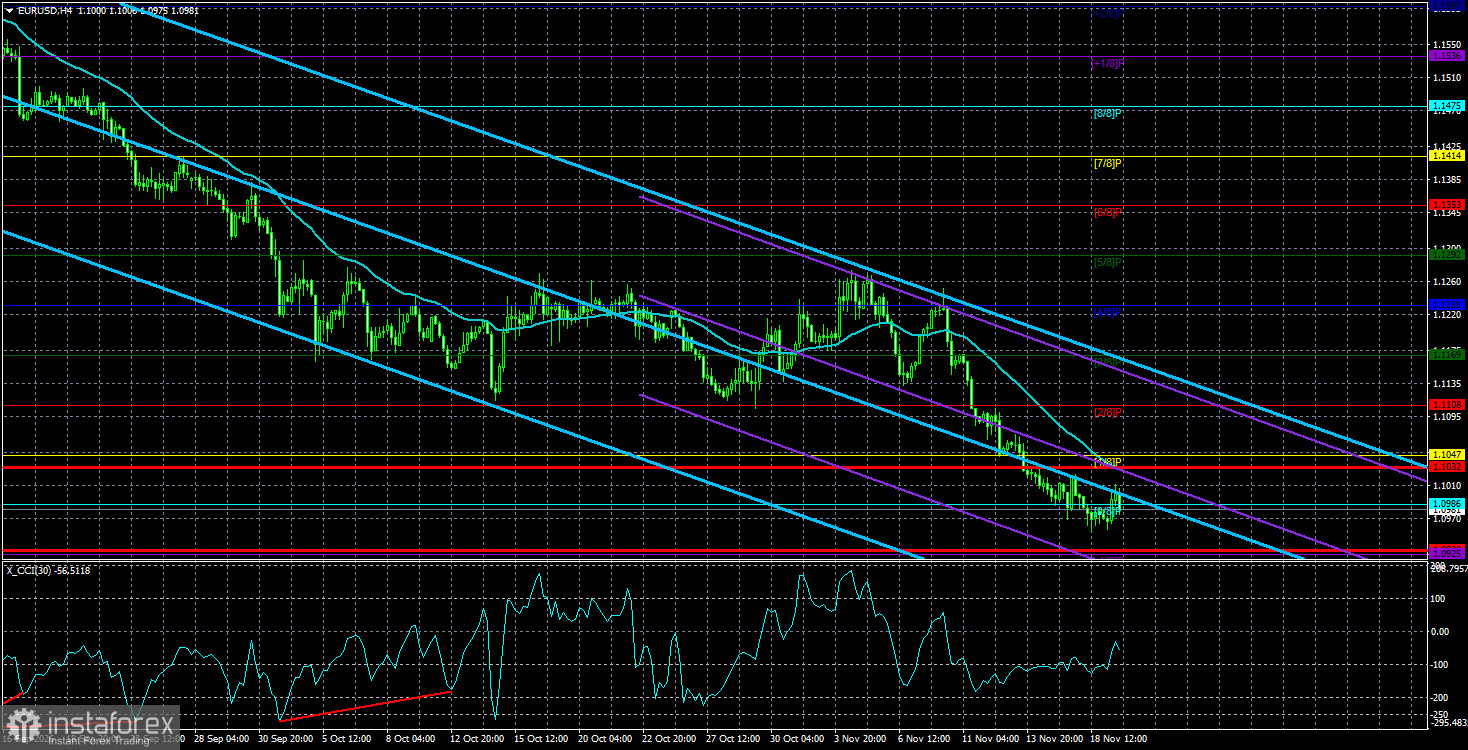
The EUR/USD currency pair traded higher on Thursday. Yes — you heard correctly — the euro rose a little during the day. What happened that the market suddenly stopped buying the dollar, which it has been doing for more than three months straight? In reality, nothing happened, and the euro's entire rise on Thursday is, as they say, laughable. This move in the euro is hard to call a correction or even a retracement. So it is not a real rise; it's just ordinary market noise.
Nevertheless, in the morning, analysts rushed to explain and justify the move. Recall that lately experts and analysts no longer analyze or forecast — they state facts. They state that the dollar has risen again, which means "hawkish" expectations about Federal Reserve policy have increased even more. That's the whole analysis. At the same time, nobody pays attention to any other factors, as if they do not exist. Yet on Thursday several analysts said the euro was rising on the back of a "hawkish" European Central Bank stance. Frankly, we don't even know how to react to that explanation.
The ECB's policy stance has not changed since the summer. By contrast, the Fed faced doubts over the summer about its ability to tighten policy because Kevin Warsh is seen as a protege of Donald Trump, and Trump pushes for lower rates rather than higher ones. The ECB does not face a "Trump problem." The ECB began raising its key rate back in the summer, set the rhythm for tightening — roughly one step a quarter — and has simply been following the planned schedule since. It's unclear on what basis analysts conclude every day that the ECB is "dovish" compared with the Fed. Although the reason is obvious — it's an attempt to explain the constant rise of the US currency.
However, on Thursday it "turned out" that the ECB is also apparently ready to tighten in December. And that tightening would be the third hike this year, unlike the Fed. Bundesbank President Joachim Nagel said a third round of rate increases will be needed to respond to rising inflation, and analysts instantly reacted. The euro rose about 40 pips — which looks rather comical.
Let us clarify the reality. The ECB will almost certainly raise rates again in December and then again early next year — effectively a third and then a fourth step — because eurozone inflation has already hit 4% and shows no signs of easing. That has been clear yesterday, a week ago, and even three months ago. So to conclude this week that the Fed's hawkishness suddenly intensified — that is unprofessional. In any case, the euro remains at rock-bottom levels.
We continue to view the current move as speculative and illogical. The market now only sees future Fed tightening — or it pays no attention to fundamentals at all and buys the dollar each day because it has been rising every day.
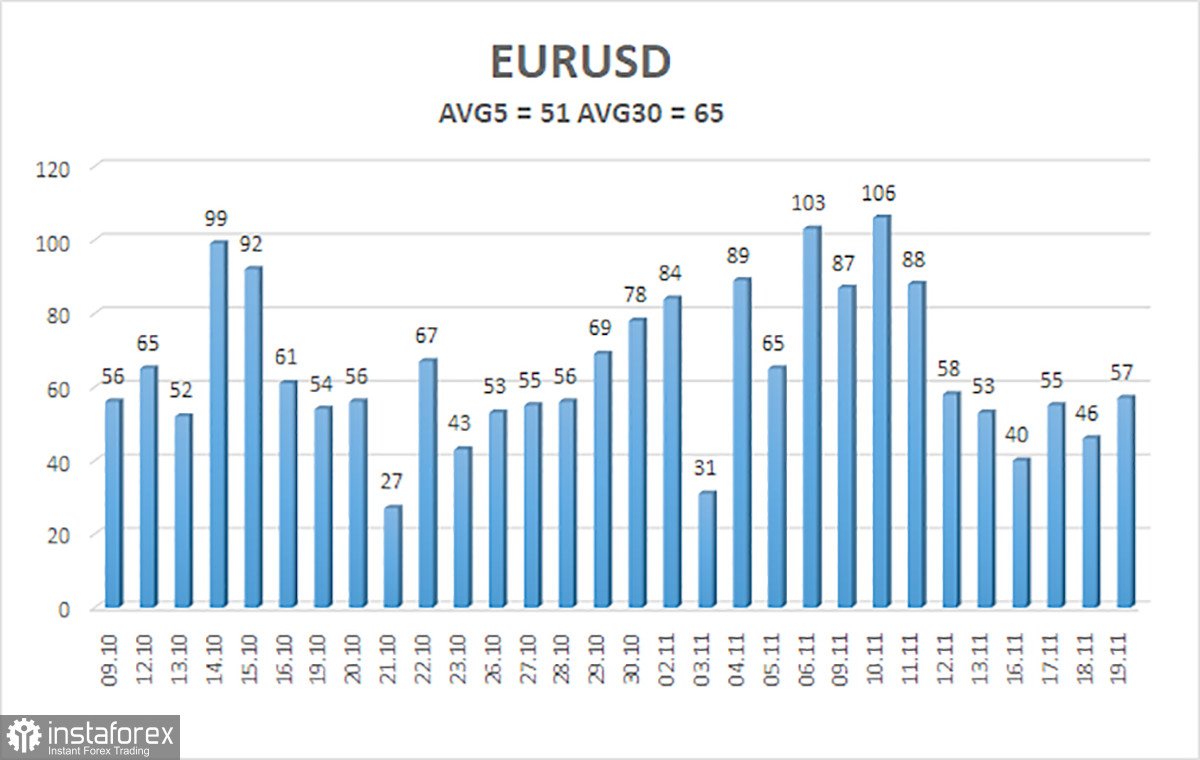
The average volatility of the EUR/USD currency pair over the last 5 trading days as of November 20 is 51 pips and is characterized as "average." We expect the pair to move between the levels 1.0930 and 1.1032 on Friday. The higher linear regression channel is directed downward, indicating a downtrend. The CCI indicator entered the oversold area five times and formed four "bullish" divergences, and all these signals were ignored. The illogical downward trend persists.
S1 – 1.0925
S2 – 1.0864
R1 – 1.0986
R2 – 1.1047
R3 – 1.1108
The EUR/USD pair remains in a downward channel with insufficient fundamental, macroeconomic, and geopolitical justification. The global fundamental backdrop for the dollar remains negative, but in 2026, geopolitics and then the Fed's hawkish stance provided strong support for the US currency. Practically all other factors have been ignored for the past three months. With the price below the moving average, shorts can be considered, targeting 1.0928 and 1.0925, since the trend remains downward. Above the moving average, long positions can be considered, targeting 1.1108 and 1.1169, because the illogical fall will end sooner or later.


