
See also


 06.11.2026 05:35 AM
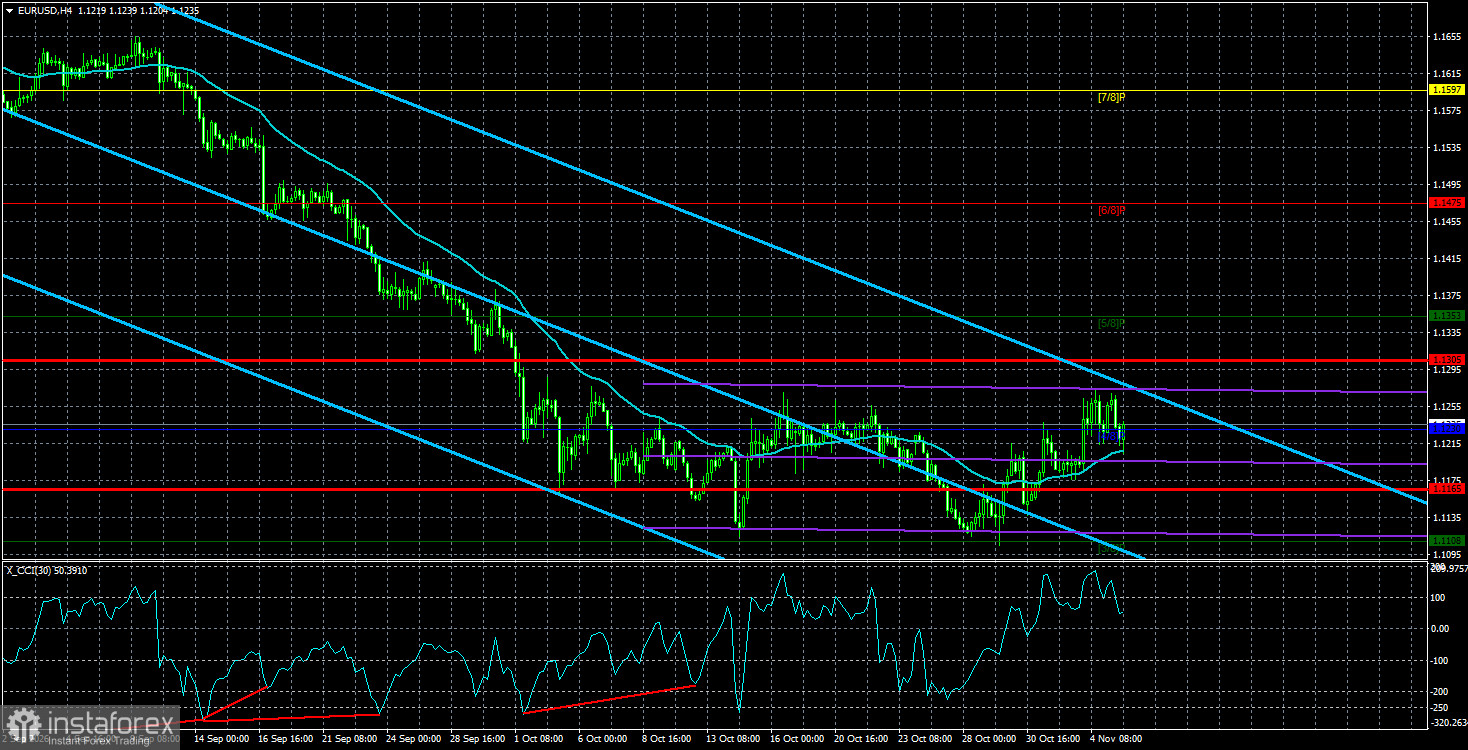
The EUR/USD currency pair traded in both directions throughout Thursday, as traders failed to reach a consensus on how to interpret the results of the US elections. On the one hand, Donald Trump has lost his complete and unconditional control over Congress. The US president can no longer make absolutely every decision independently without consulting Congress. On the other hand, the powers of the US president are extensive, meaning that congressional approval is still unnecessary for many of Trump's decisions.
One important detail should be taken into account. Donald Trump may act unconstitutionally. For the occupant of the White House, this is an entirely normal practice. For example, Congress could vote to end the war with Iran, but Donald Trump could veto the bill or simply ignore it. The war would resume, the Democrats would appeal to the Supreme Court, and the Supreme Court would spend a year considering another case involving Trump. By the time the court issued its ruling, the war with Iran might already be over. Therefore, the loss of control over Congress is unlikely to be a problem that would prevent Donald Trump from carrying on with his presidential duties.
There are only a few issues on which Trump will have to negotiate with the Democrats. The budget is one example. The Democrats could block any new spending proposals put forward by the US president. Trump wants to continue the war with Iran, which requires additional funding. Therefore, until the Democrats approve next year's budget, the United States could face another government shutdown, and Trump would not receive additional funds for military operations. However, even in this situation, a way around the problem may be found. The United States has reserve funds that Trump can access. After all, the US president is highly skilled at interpreting various laws and applying them broadly. It would not be surprising if Trump redirected some healthcare funding toward the war in Iran, claiming that he has every right to do so because both expenditures fall within a similar area of budget spending. The Democrats would then have to prove in court that Trump had no legal right to take such action. While the courts considered all the lawsuits, Trump's presidential term would come to an end. He will certainly not become US president for a third time.
Thus, the Republican president makes better use of the opportunities provided by US legislation than many of his colleagues. Consequently, there is strong reason to believe that Trump will find a way to resume the war in the Middle East if he wishes to do so. Moreover, the president himself acknowledged that the war with Iran was the reason behind the Republicans' defeat in the elections. Therefore, it would not be surprising if Trump sought to retaliate against Tehran.
Two days ago, the oil market reacted very positively to the election results. The reasoning was straightforward: Trump had lost the election, meaning that the war would soon end and oil prices would fall to $60–70 per barrel. Against this background, oil prices did indeed decline from $116 to $97 per barrel. However, on Thursday, Brent and other oil benchmarks began rising again as markets started questioning whether events would unfold as easily and favorably as initially expected following the elections. As for the European currency, it managed to climb to the 1.1270 level, which can be considered the upper boundary of the sideways channel that has been in place for the past month, before immediately retreating. Nothing has changed for the euro this week: the market continues to show little interest in buying the currency.
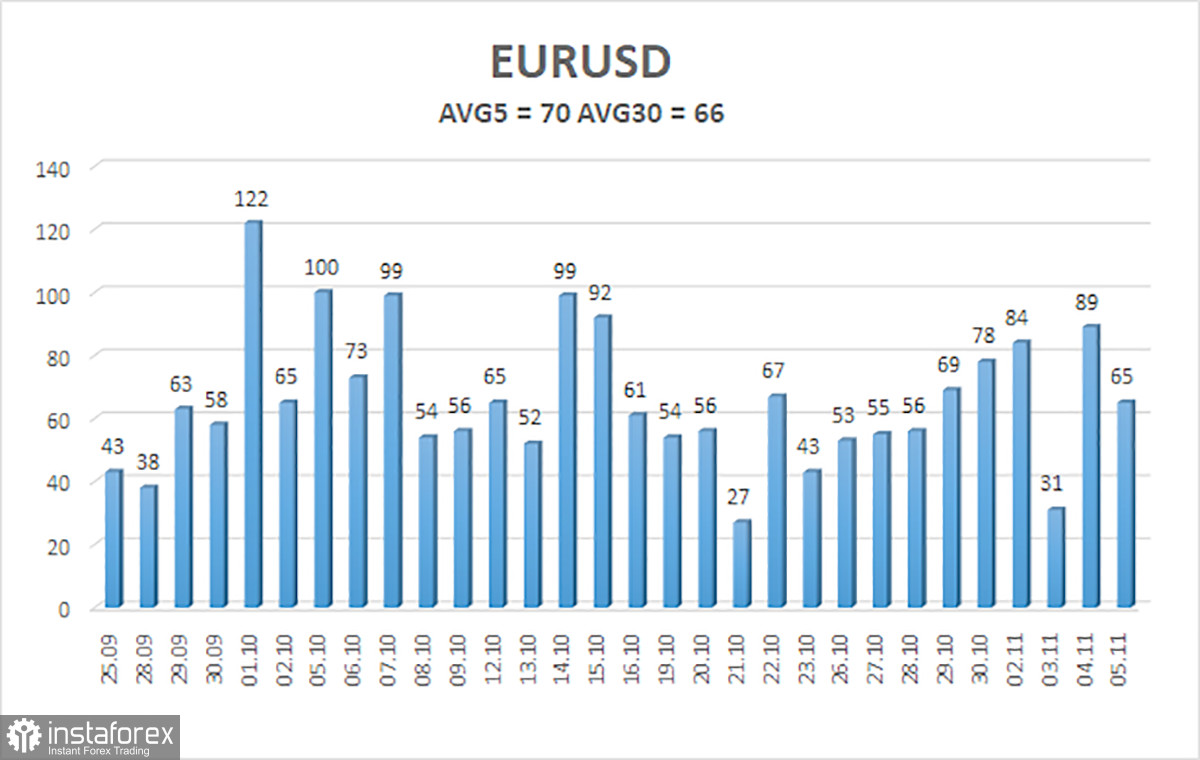
The average volatility of the EUR/USD currency pair over the last five trading days, as of November 6, stands at 70 points and is classified as "medium." On Friday, the pair is expected to trade between the 1.1165 and 1.1305 levels. The higher linear regression channel is pointing downward, indicating another potential trend reversal. The CCI indicator entered the oversold territory five times and formed four bullish divergences, but traders ignored all these signals. The irrational downward trend remains in place.
Nearest Support Levels:
S1 – 1.1108
S2 – 1.0986
S3 – 1.0864
Nearest Resistance Levels:
R1 – 1.1230
R2 – 1.1353
R3 – 1.1475
Trading Recommendations:
EUR/USD remains in a downward trend that lacks sufficient fundamental, macroeconomic, and geopolitical factors to justify further declines. The overall fundamental background remains unfavorable for the US dollar. However, in 2026, geopolitical developments, followed by the Federal Reserve's hawkish stance, provided substantial support for the US currency. If the price remains below the moving average, short positions can be considered with targets at 1.1165 and 1.1108. If the price moves above the moving average, long positions become relevant, with targets at 1.1305 and 1.1353.
Explanations for the Charts:
Linear regression channels – help identify the current trend. If both channels point in the same direction, the current trend is strong.
The moving average (settings: 20.0, smoothed) identifies the short-term trend and indicates the preferred trading direction.
Murray levels serve as targets for price movements and corrections.
Volatility levels (red lines) indicate the probable price channel within which the currency pair is expected to trade over the next 24 hours, based on current volatility readings.
The CCI indicator: entry into oversold territory (below -250) or overbought territory (above +250) indicates that a reversal in the opposite direction may be approaching.


