
See also


 05.11.2026 02:13 PM
Yesterday, US spot Bitcoin ETFs drew $74.6 million, ending a three-session outflow streak, while Ethereum funds added $53 million and halted a seven-day sell-off that totaled $657 million. The reversal coincided with the market bounce after the midterms, when Bitcoin reclaimed $80,000, and US stocks rallied on the Democrats' victory. Previously, outflows from Bitcoin funds slowed from $643 million on Friday to $399 million on Monday and $116 million on Tuesday, and have now flipped to inflows. That reduced ETF net losses for 2026 to roughly $79 million from $153 million the day before.

The inflows were unevenly distributed. Fidelity's FBTC raised about $237 million and topped the list, while BlackRock's flagship IBIT lost another $201.2 million. IBIT's outflow streak reached four consecutive sessions totaling $935.2 million. This shows buyers are moving into lower-fee, smaller funds while capital leaves the largest product — a win for Fidelity and a flow loss for BlackRock. Excluding those two funds, the rest added about $39 million combined.
Many traders believe the market had already priced in a Democratic win, and the removal of uncertainty only brought relief. Institutional flows and overall risk appetite are likely to dominate in the near term. However, I view one day of inflows as a test rather than a confirmed reversal. The condition for holding above $80,000 was a return of ETF money, and the first confirmation has come — but IBIT continues to lose assets, and most inflows were concentrated with one issuer. If funds sustain positive flows in the coming sessions, I expect Bitcoin to move toward $81,800. If inflows revert to outflows, a pullback will take price back to $79,300 and lower.
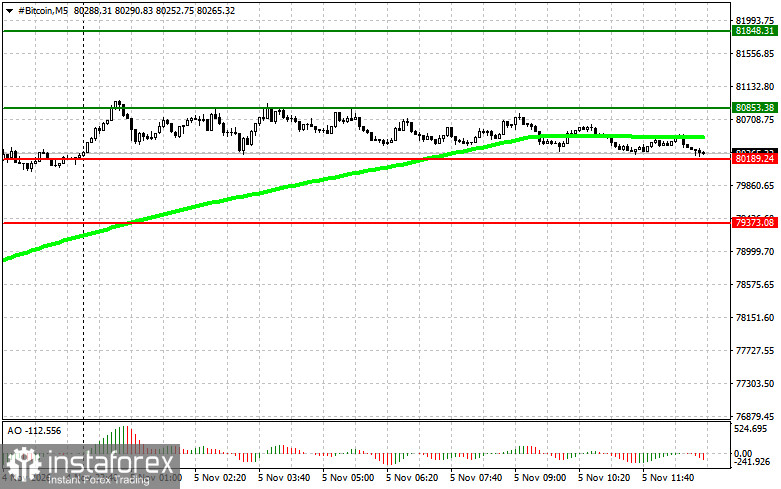
Bitcoin
The market is trading in a narrow range between $80,200 and $80,800, and the plan covers two mirror scenarios with full breakout and rejection setups. A buy is considered on a break above $80,800, provided price stays above the 50-day moving average and the Awesome Oscillator is above zero; the target is $81,800, where profits should be taken and a short on the pullback considered. If a drop below $80,200 proves false and price returns, buy from that level, targeting first $80,800 and then $81,800.
Sell scenarios are symmetrical. A confirmed break below $80,200, with the MA above price and Awesome below zero, opens a short targeting $79,300. If an upside break above $80,800 fails, a short on the rejection targets a return to $80,200 and then lower to $79,300.
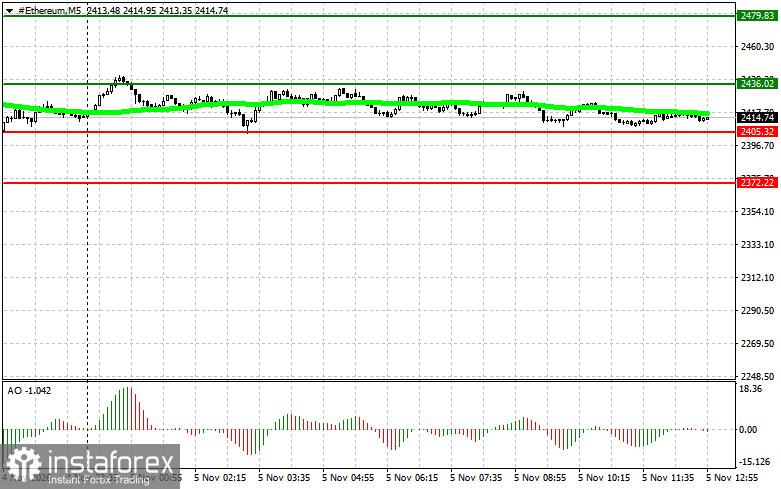
Ethereum
The logic mirrors Bitcoin on its own price scale: the range is set by $2,411 and $2,436, with additional reference points at $2,372 (support) and $2,479 (resistance). Buy on a break above $2,436 while price is above the 50-day MA and Awesome > 0, targeting $2,479 where profit is taken; or buy if a downside false break below $2,411 occurs and price returns first to $2,436 and then to $2,479.
Sell on a confirmed break below $2,411 when the MA is above price and Awesome < 0, targeting $2,372; or go short on a failed attempt to break $2,436 with a return first to $2,411 and then to $2,372.
Both indicators serve as filters to weed out false moves rather than standalone entry signals, and trades are opened only after the price confirms the specified levels.


