
আরও দেখুন


 23.11.2026 05:34 AM
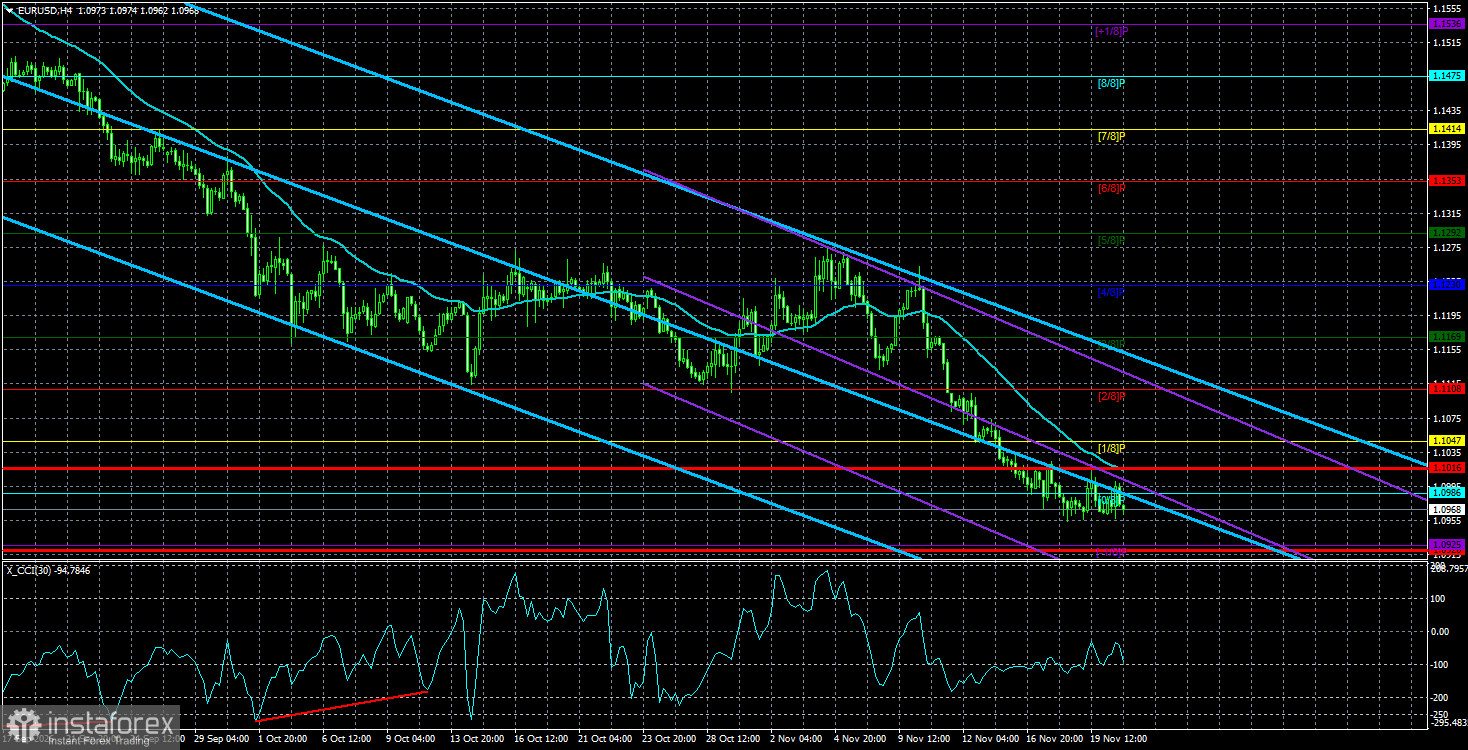
On Friday, EUR/USD remained inside the narrow price range that formed in the second half of last week. In general, the euro once again pierced another "low," failed to correct, and showed no desire to rally. The market again showed it cares only about the US currency and isn't even willing to take profits on positions it has been accumulating for three months. Based on the currency market's mood alone, one must conclude the euro is likely to continue falling.
What drove EUR/USD lower last week? In reality — nothing. No fundamental or macroeconomic events provided unconditional support for the dollar. Start with the two most "important" items. (We put "important" in quotes because they were important only on paper.) Federal Reserve Chair Kevin Warsh said nothing about monetary policy in his San Francisco remarks, and the Fed minutes are always a formality and already dated. Yet the dollar kept rising or at least refused to fall. Traders and analysts therefore scrambled to explain dollar strength despite the lack of any meaningful new information.
Of course an explanation was found. First: "hawkish expectations about Fed policy continue to rise." Second: Kevin Warsh said nothing dovish and didn't try to dissuade the market from expecting further rate increases. Third: the Fed minutes looked more hawkish than expected. And that was all — the puzzle was "solved." No other events were needed. Is the Fed more hawkish? That alone suffices.
What is most striking is how Fed remarks are now interpreted. Recall that last summer Kevin Warsh twice triggered sell-offs in EUR/USD and GBP/USD by warning that high inflation is unacceptable in the U.S.; the market immediately began pricing in more tightening. Now, if Warsh says nothing, the market treats that silence as a hawkish sign. The Fed chair never commenting on future moves is passe; Warsh not mentioning inflation this time didn't matter. In effect, Warsh said nothing about policy, inflation, or geopolitics, yet the market read his silence as hawkish.
We should also "review" the Fed minutes — the meeting was three weeks before publication. The market has already priced in a December hike, and we believe traders have already started pricing in the March move. Yet the October minutes — plainly dated by now — were again read as "more hawkish." Recall the Fed left rates unchanged in October even though the vote paused action; that was interpreted as hawkish. The result: the dollar appreciated again, the euro failed to produce even a minimal retracement, and the market keeps moving on a single factor while ignoring everything else.
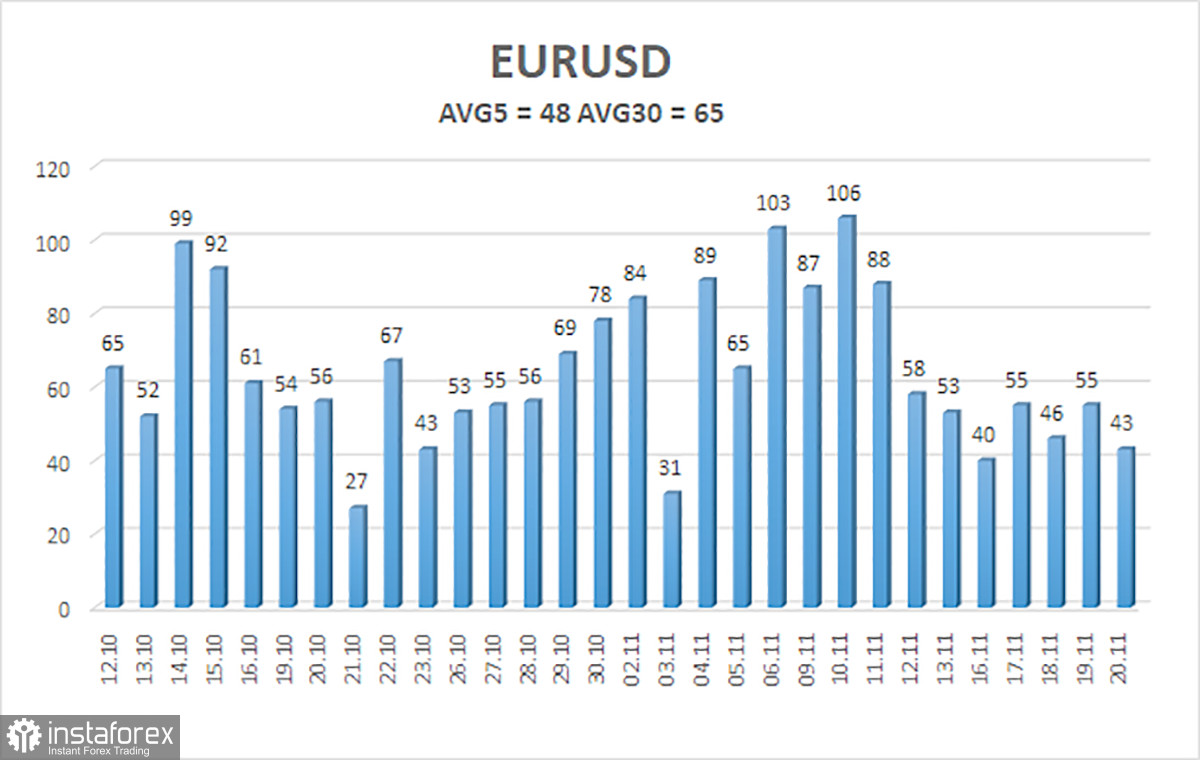
The average volatility of the EUR/USD currency pair over the last 5 trading days as of November 23 is 48 pips and is characterized as "average." We expect the pair to move between the levels 1.0920 and 1.1016 on Monday. The higher linear-regression channel is directed downward, indicating a downtrend. The CCI indicator entered the oversold area five times and formed four "bullish" divergences, and all those signals were ignored. The illogical downward trend persists.
S1 – 1.0925
S2 – 1.0864
R1 – 1.0986
R2 – 1.1047
R3 – 1.1108
The EUR/USD pair remains in a descending channel with insufficient fundamental, macroeconomic, or geopolitical justification. The global fundamental backdrop for the dollar is negative overall, but in 2026, geopolitics first and then the Fed's hawkish tilt have provided strong support for the US currency. Practically all other factors have been ignored over the past three months. With price below the moving average, consider shorts with targets of 1.0925 and 1.0920, since the trend remains downward. Above the moving average, consider long positions with targets of 1.1108 and 1.1169 — the illogical decline will end sooner or later.


